_1773179633783-DiqUK4T2.png)
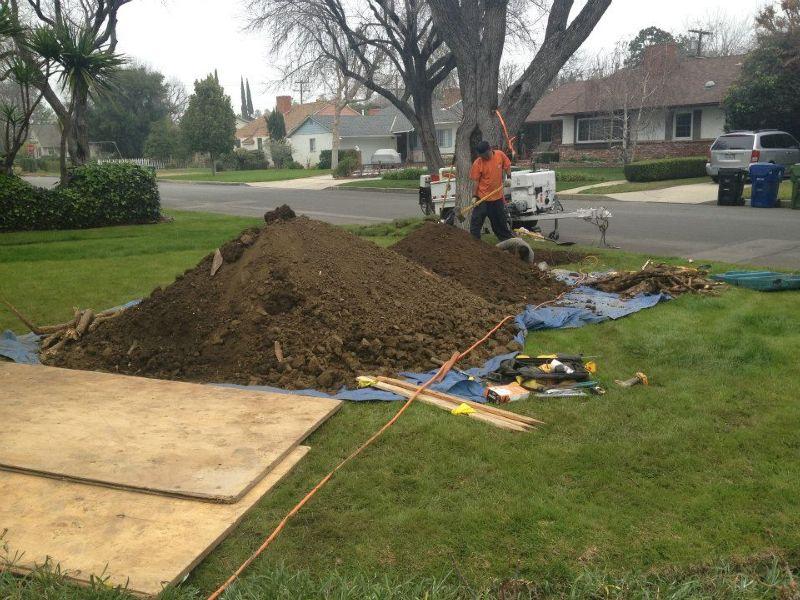
Woodland Hills is geographically enormous compared with most of the communities we serve, and that size is the first thing a sewer contractor has to reckon with. The northern end is office towers and apartment density around Warner Center. The middle is postwar tract housing on the Valley floor either side of Ventura Boulevard. The southern end climbs into the Santa Monica Mountains toward Mulholland Drive, where lots are large, streets are narrow and steep, and the ground turns to rock. Those three areas share a name and almost nothing else underground.
BBC Rooter & Plumbing works on sewer laterals, main drains and underground pipe, and only on those. We are based in Northridge, we run down De Soto or Topanga into Woodland Hills daily, and we are set up for both a high-rise commercial line and a hundred-foot hillside lateral behind an oak tree. If you have a backup happening now, call 818-280-9135; the phone is answered every day.
Warner Center: High Density on a Valley Floor Sewer Grid
The Warner Center district, laid out on land that once belonged to Harry Warner's ranch and redeveloped from the 1970s onward as the Valley's high-rise business core, concentrates offices, hotels, restaurants and large apartment complexes into a small footprint around Owensmouth, Canoga and De Soto Avenues. The drainage serving those buildings is nothing like a house lateral. It is large-diameter private sewer, often running long distances beneath parking structures, plazas and fire lanes before it reaches a city main.
Commercial work of that kind is a different discipline from residential rooter service. Access points are scarce and frequently paved over. Documentation of what was built, and of what was modified during a later tenant improvement, is often missing or wrong. Shutting a line down during business hours is not an option. Our approach is to build an accurate picture first with camera inspection and surface locating, restore capacity with hydrojetting, and then repair or line only the segments that are actually failing. Food service tenants get their grease interceptors serviced on a schedule instead of an emergency, which is the difference between a planned maintenance cost and a closed kitchen on a Friday night.
South of Ventura: Hillside Laterals in the Santa Monica Mountains
Turn off Ventura Boulevard onto any of the streets climbing toward Mulholland — Dumetz Road, Wells Drive, Serrania Avenue and the lanes branching off them — and the job changes completely. Homes sit on cut pads carved into slopes of shale and sandstone. Sewer laterals run long, drop hard, and frequently take a route around the side of the house that no equipment can follow without going through a retaining wall or a garden.
Three things make hillside sewer work here distinct. The ground is rocky, so excavation is slower and more expensive per foot than anything on the Valley floor and hand digging near the pipe is often unavoidable. Grade is steep enough that water regularly outruns solids, leaving deposits stranded on the pipe wall partway down and creating stoppages that appear to have no cause. And access is genuinely constrained: narrow streets with no parking, sharp driveways, and lots where the only path to the lateral is a set of stairs. Trenchless replacement pays for itself fastest exactly here, because the alternative is trenching down a terraced hillside.
Sewer Trouble Anywhere from Warner Center to Mulholland?
Camera first, written number second, work third. Seven days a week.
Call 818-280-9135The Trees Victor Girard Planted Are Still Working on Your Pipe
When Victor Girard laid out this community in 1922 he was selling lots on land that was essentially bare, so he planted trees by the thousand along the boulevards to make the place look established. It worked, the name Woodland Hills eventually followed, and a century later the canopy is one of the neighborhood's defining features. It is also the reason a large share of our calls here are root calls.
Mature coast live oak, western sycamore and Southern California black walnut are all present in quantity, along with decades of planted liquidambar, ficus and eucalyptus. Woodland Hills also happens to be one of the hottest places in Los Angeles County, and in a long dry summer the soil column holds very little available moisture. The one reliable damp spot within reach is the vapor leaking from a sewer joint. Roots follow that gradient, arrive as hairs at a hairline crack, and thicken into a mat that catches everything passing by.
There is a wrinkle here that homeowners in other neighborhoods do not face as often. Native oaks, sycamores and black walnuts are protected trees under City of Los Angeles rules, and removing or heavily cutting one is not a decision a property owner can make unilaterally. That is usually fine, because removing the tree was never the efficient answer anyway. Sealing the pipe is. A cured-in-place liner converts a jointed lateral into one continuous pipe with no entry point, the intrusion problem ends, and the tree keeps its roots and its canopy.
What the Camera Usually Finds Under Woodland Hills
Building eras here run from the 1920s through today, so the pipe inventory is broad. These are the conditions we film most often and what each one means for the repair.
Root mats at clay joints
On the older flats and the early hillside streets, four-inch vitrified clay with a joint every few feet remains common. The pipe body is usually intact and the joints are wide open to roots. This is the classic candidate for jetting followed by lining, because the host pipe still has the strength to carry a liner.
Scaled and channeled cast iron
Mid-century tract houses left the building in cast iron. After six or seven decades the crown is heavily scaled, the invert has corroded thin, and diameter is a fraction of the original. Descaling restores flow, but a line that has channeled through the bottom is on borrowed time and gets replaced.
Slope defects on the hill lots
Steep laterals produce a specific pattern: deposits stranded where the pitch eases, joints pulled slightly open by long-term slope creep, and occasionally a section that has shifted after a wet winter. These are pinpoint problems, and a locate on the surface keeps the excavation small.
Why the diagnosis is worth more than the guess
Rock excavation and hillside access make an unnecessary dig expensive in Woodland Hills. Twenty minutes with a camera and a locator regularly turns an assumed replacement into a single-joint repair.
When replacement genuinely is the answer, lining or bursting usually gets it done from small pits rather than a trench across a slope that took a landscape architect to build.
Condominiums, Townhomes and the Question of Who Owns the Line
Woodland Hills carries a large stock of condominium and townhome complexes, particularly in the corridor between Ventura Boulevard and Victory Boulevard and around the edges of Warner Center. Those developments almost always drain through a private sewer system owned in common: individual unit stacks feed a shared underground main that crosses landscaping, guest parking and fire lanes before it reaches the city connection at the street.
When a ground-floor unit backs up in a complex like that, the first argument is usually about responsibility rather than plumbing, and it is an argument nobody can settle without knowing where the pipe actually runs. We approach those jobs by camera surveying the shared main, locating and marking the alignment on the surface, and identifying the exact footage of the defect and which branch it sits on. Boards and property managers can then make a decision based on a recording and a mark on the pavement instead of a guess. Where the shared main is old jointed pipe under paving, lining a segment is frequently far cheaper for an association than trenching a parking court and repaving it.
Drain Cleaning in Woodland Hills: What Actually Clears a Line Here
Most of the drain cleaning calls we take in Woodland Hills are not sink or shower problems at all. They are main line stoppages presenting at the lowest fixture in the building, and the distinction matters because the two are cleared with entirely different equipment. A branch clog is a twenty minute job at the fixture. A main line stoppage is a cable or a jetter run from a cleanout, and if the technician who shows up does not carry both, you get a temporary opening and a return visit in six weeks.
The geography drives what we find in the pipe. North of Ventura Boulevard, on the flat ground toward Warner Center, the laterals are long, shallow and mostly clay or early cast iron, and the recurring cause is root intrusion at the joints followed by paper and grease collecting on the roots. South of Ventura, on the slopes into the Santa Monica Mountains, the runs are steep with abrupt transitions, and the stoppage is more often solids stalling where the grade flattens out at the bottom of a hillside run. On commercial lines along Ventura Boulevard and inside Warner Center, it is almost always grease and scale narrowing the pipe over years rather than any single object.
Our sequence on a Woodland Hills main line is consistent: locate and open a proper cleanout, cable the line to restore flow first so the building is usable, then put a camera down the pipe to see what caused it. That last step is the one most drain cleaning calls skip, and it is the reason the same house calls again the following season. If the camera shows roots at a joint, hydrojetting cuts them back and a liner closes the joint for good. If it shows a belly or an offset, no amount of cleaning fixes it and you deserve to know that before you pay for a fourth clearing.
We do not charge for the camera as a separate diagnostic on a drain cleaning job we have already opened — you watch the footage with the technician, we mark the defect location on the surface, and any repair estimate is written down before you decide anything.
Sewer and Underground Pipe Services in Woodland Hills
One trade, done in house, on residential and commercial property alike:
To be explicit about the boundary of our trade: we are not the company to call for a water heater or tankless unit, a faucet, a toilet, a sink, a garbage disposal, a water softener, a copper repipe, gas piping or new construction rough plumbing. Sewer lines and underground drainage are what we do, all day, every day.
Pipe Lining in Woodland Hills, and Why It Usually Beats Digging Here
More sewer laterals get rebuilt in this part of the Valley with a cured-in-place liner than with a shovel, and the reason is mostly what sits on top of the pipe. Woodland Hills yards are old, planted and expensive. A trench cut through a forty-year-old landscape does not grow back in a season, and on the terraced lots south of Ventura it can mean pulling out a retaining wall to get a machine down to the run.
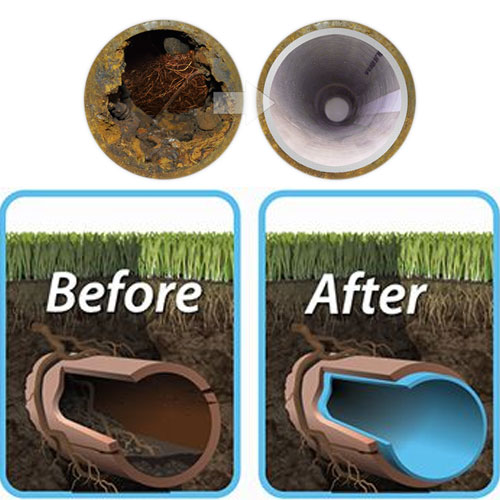
Lining sidesteps that. We clean and descale the existing lateral, camera it end to end, then pull a resin-saturated liner through the host pipe and cure it in place. What comes out the other side is one continuous, jointless pipe formed inside the old one, with no open joints for a root to find. Access is a cleanout and, if the run needs it, a single small pit — not a trench across the yard.
Two Woodland Hills conditions make that especially worth knowing about:
The oaks are protected, and roots are the usual culprit. Coast live oaks across the hillside tracts fall under the City of Los Angeles protected tree rules, which means the tree that is wrecking your lateral is frequently the tree you are least free to disturb. Cutting roots to open a trench beside one is a permitting problem before it is a plumbing problem. Rebuilding the pipe from the inside removes the root pathway without touching the root plate.
Warner Center runs under pavement, not lawn. Commercial and multi-tenant laterals around the Warner Center blocks typically cross a parking field or a drive aisle. Restoring saw-cut asphalt and re-striping stalls routinely costs more than the pipe work itself, and it takes the parking out of service while a tenant is trying to trade. Lining a line under a lot keeps the surface intact and the business open.
We will also tell you when lining is the wrong tool, because it frequently is. A liner needs a host pipe that still holds its shape. If the camera shows a section that is fully collapsed, badly offset at a joint, or crushed flat, there is nothing left to line against — that run gets replaced, usually by pipe bursting or by a spot excavation on the failed length, with the sound remainder lined afterward. A lateral that has settled into a belly has a grade problem, and a liner installed inside a belly is still a belly. That one gets dug and re-graded, and we will say so at the estimate rather than after.
When a Woodland Hills Line Is Trying to Tell You Something
Between hillside grade, deep-rooted protected trees and sixty-year-old pipe, the signals here are worth taking seriously early:
- Backups that follow the seasons — trouble every spring as roots push growth, or after the first heavy rain when saturated soil moves
- A downhill fixture surrendering first on a hillside lot, often a lower-level bathroom or a garage drain, while the rest of the house seems fine
- A patch of lawn or slope that stays green and soft through a Woodland Hills August with no irrigation reaching it
- Toilets that gurgle or drop their level whenever a large volume is discharged elsewhere in the building
- Repeat service calls on a commercial line that a cable clears for a few weeks at a time, which points at grease or scale rather than an object
- Cracking or lifting hardscape tracing the path from the building toward the street
Have it scoped. You watch the footage with the technician, we mark the location on the surface, and the estimate is written down before any decision has to be made.
Dispatch and Coverage
Our trucks come out of Northridge and typically reach a Woodland Hills address in thirty to sixty minutes, longer if the job is well up into the hills at rush hour. Commercial and multi-tenant work can be scheduled early morning or after hours so occupied buildings are not disrupted.
Woodland Hills Sewer Questions We Hear Most
My house is up in the hills off Mulholland. Does the rocky ground make sewer repair more expensive?
It affects the excavation, not the diagnosis. Digging through shale and sandstone in the Santa Monica Mountains is slower than digging Valley alluvium, and hand work near the pipe is often required, so open trenching on a hillside lot costs meaningfully more per foot. That is the main reason we push hard toward trenchless methods here. Lining and pipe bursting work from small pits at each end of the run, which removes most of the rock excavation from the equation.
There is a big oak over my sewer line. Do I have to take it out to stop the roots?
Almost certainly not, and in many cases you could not anyway. Native oaks, western sycamores and Southern California black walnuts are protected under City of Los Angeles tree rules, so removal or major cutting requires going through the city. The practical solution is to close the pipe rather than remove the tree. Roots can only enter through open joints and cracks, so a cured-in-place liner that seals the inside of the lateral ends the intrusion permanently while the tree stays where it is.
We manage a building in Warner Center. Can you work without shutting the property down?
Yes. Commercial jetting, camera inspection and most lining work can be scheduled early morning, evening or overnight so tenants and customers are not affected. On a large private sewer system we usually start with a full camera survey and a surface locate to map what actually exists, since as-built drawings for buildings of that vintage are frequently missing or no longer accurate after tenant improvements. From there we sequence the work segment by segment.
What is the difference between hydrojetting and running a cable, and which do I need?
A cable is a mechanical tool that bores an opening through a blockage. It is the right choice for a hard stoppage when you need flow back immediately. Jetting uses high pressure water through a specialized head to strip the full inside wall of the pipe and flush the debris downstream and out. For roots, grease and scale, jetting removes far more material and the results last much longer. In practice we often cable first to open the line, then jet and camera to deal with the underlying cause.
Is a sewer camera inspection worth it before buying in Woodland Hills?
It is one of the highest value inspections available here, because the housing stock spans nearly a century and a general home inspection never puts a camera in the sewer. A scope tells you the pipe material, the depth at the street, whether roots are already established, and whether a hillside run has slope defects. Given what hillside excavation costs in this part of the Valley, knowing the condition of the lateral before you close is worth considerably more than the inspection fee.
How long does a lateral replacement take, and do you handle the permit?
A typical residential lateral replacement is a one day job once the line has been cleaned, scoped and permitted, with longer runs, multiple bends or heavy rock pushing into a second day. Sewer replacement in the City of Los Angeles is permitted and inspected work, and we take care of the permit as part of the project. You get the schedule in writing with the estimate, before any equipment shows up.
My main line in Woodland Hills backs up two or three times a year. Is repeat drain cleaning normal?
No. A healthy lateral should not need clearing on a schedule. Repeat stoppages at a predictable interval are a symptom, and the interval itself tells you a lot: roughly annual and seasonal points at root intrusion, every few months on a commercial line points at grease or scale buildup, and irregular repeats that get closer together usually mean a structural defect such as a belly, an offset joint or a partial collapse holding solids. The fix is to camera the line once rather than cable it four more times. Once you can see the cause, the choice between jetting, lining and replacement becomes obvious and you stop paying for the same visit.
Do you charge extra for weekend or same-day drain cleaning in Woodland Hills?
No weekend or holiday premium. We are open seven days a week, six in the morning to six in the evening, and trucks come out of Northridge, so a Woodland Hills address is typically thirty to sixty minutes out. Commercial and multi-tenant jobs can be scheduled early morning or after hours so an occupied building is not disrupted, at the same rate.
More of the Valley We Serve
Same crews, same equipment, the rest of the San Fernando Valley. Choose a neighborhood:
Book a Woodland Hills Sewer Camera Inspection
BBC Rooter & Plumbing. CSLB #720343. Underground pipe specialists, open every day 6am to 6pm.
Call 818-280-9135