_1773179633783-DiqUK4T2.png)
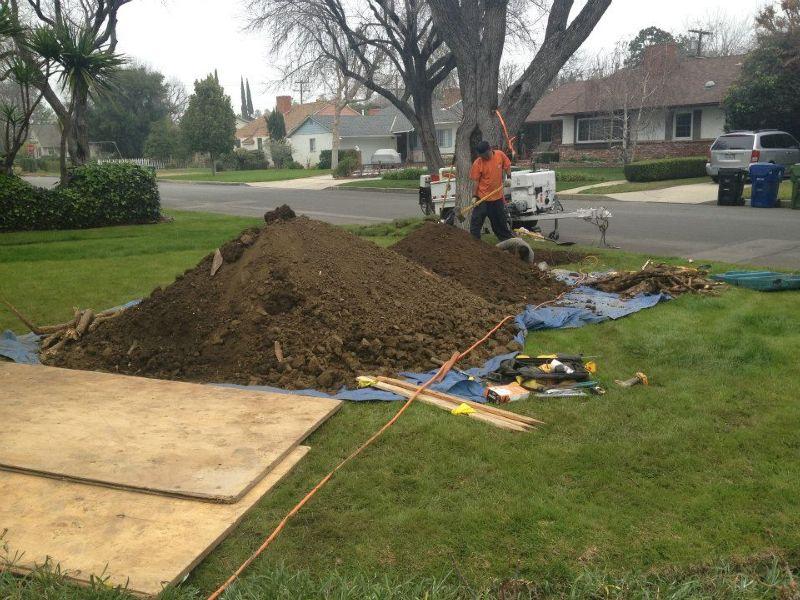
BBC Rooter & Plumbing works underground. Sewer laterals, main line stoppages, root-choked clay joints, failed cast iron, and the excavation or trenchless rehabilitation that puts them right — that is the whole job description, and Granada Hills is one of the neighborhoods our trucks are called into most. We dispatch from Yolanda Avenue in Northridge, a straight shot up Balboa or Zelzah, so most Granada Hills addresses are inside a half-hour drive.
What follows is not a generic service description. It is what our crews actually meet under this particular slice of the north Valley: the grades, the backfill, the pipe materials, and the trees that decide whether a lateral here survives eighty years or twenty. If something is backing up while you are reading this, stop and call 818-280-9135. Somebody picks up seven days a week.
Granada Hills Sits on a Slope, and Your Sewer Line Knows It
Most of the San Fernando Valley floor is flat alluvium, and most Valley sewer laterals run at close to the minimum fall a plumber can legally build. Granada Hills is only half that story. South of Chatsworth Street the blocks behave like the rest of the Valley — long, level, shallow pitch to the main. North of Rinaldi Street the ground starts climbing toward the Santa Susana Mountains and O'Melveny Park, and on the streets above Sesnon Boulevard the grade is genuine: driveways pitch, back yards terrace, and the sewer lateral leaves the house sitting well above the elevation of the pipe in the street.
Grade cuts in both directions. A steep run scours itself; solids move fast and rarely settle. But excessive fall lets water outrun the solids it is supposed to carry, and the waste is left stranded on dry pipe wall partway down the hill. The trouble spot in a sloped Granada Hills lateral is almost never in the middle of the steep section — it is where that steep section abruptly flattens out, usually near the property-line cleanout. Debris drops out exactly at the break in pitch. When we run a camera on a hillside lot here, the blockage turns up within a few feet of that transition more often than anywhere else.
On the flatter blocks toward Devonshire and Chatsworth Street the failure is the opposite: bellies. A trench backfilled loose in 1956 keeps settling for decades, the pipe droops into a shallow sag, standing water never drains out of it, and solids drop into the pool. That house gets a stoppage every few months regardless of how often a cable is run through it, because a cable only punches a channel through the accumulation. Hydrojetting scours the belly clean to the pipe wall and buys real time. The only permanent answer to a true belly is restoring the grade of that section, either with a spot excavation or by pulling a new pipe through on the correct line.
Three Building Eras, Three Different Pipes Underground
Granada Hills grew out of Sunshine Ranch, the English walnut operation that covered this ground before the war, and it was renamed and subdivided in stages rather than all at once. That staged growth is why one street can hand us a 1930s clay lateral and the street behind it a 1960s cast iron one. Before a crew commits to a repair method we want to know which era we are standing on, because the failure mode and the fix are completely different.
Vitrified clay on the old ranch parcels
The pre-war houses on the deep lots off Zelzah, White Oak and Balboa were plumbed in four-inch vitrified clay laid in short hub-and-spigot sections with mortared joints. Clay itself is nearly immortal and shrugs off chemicals. Its weakness is the joint every two to three feet, and after ninety years those joints are open enough for a root hair to find.
Cast iron from the tract boom
Houses built through the 1950s and 1960s generally left the slab in cast iron. Iron corrodes from the inside out, scale builds along the crown and shoulders, and the invert channels until the bottom of the pipe is thin enough to break through. Sixty to seventy-five years in, that is precisely where much of Granada Hills now sits.
Orangeburg in the postwar gap
Where iron was scarce, some late-1940s and 1950s laterals were run in Orangeburg, a bituminized fiber conduit rolled from wood pulp and tar. It does not crack so much as deform, flattening into an oval under soil load until the opening closes. If a camera shows an egg-shaped pipe, it is Orangeburg, and it is replaced rather than repaired.
Post-1970 infill and the newer pockets on the north edge are usually ABS, the black plastic drain pipe that became standard in California residential work. ABS is a far better material than anything that preceded it, but it is not exempt from bad bedding, crushed sections under a later driveway pour, or joints pulled apart by soil movement.
Why we camera first, always
Pipe material, depth, slope, joint condition and the exact footage of a defect all come off the same camera and locate. Guessing at any one of them is how a repair estimate doubles halfway through the day.
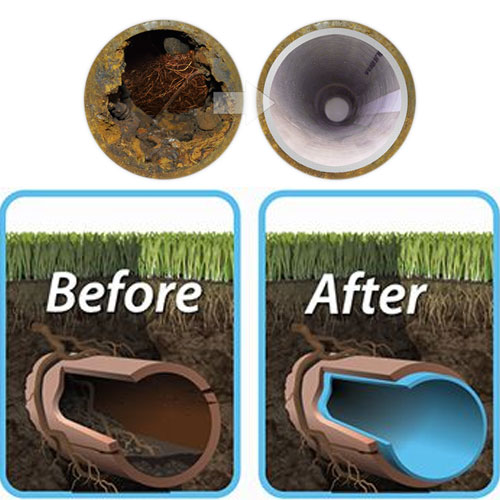
Once we know what is down there, pipe lining or pipe bursting can usually rebuild the lateral from one or two small pits instead of a trench across a lawn, a mature hedge or a stamped-concrete driveway.
The Trees That Cause Us the Most Work Here
Granada Hills is a green neighborhood by Valley standards, and that is the direct cause of a large share of our rooter calls. Walnut survivors from the ranch era are still standing on some parcels. Parkways carry mature liquidambar, Chinese elm, ficus and coast live oak, and White Oak Avenue is famous locally for the tall deodar cedars planted along it. Every one of those species sends roots hunting for moisture, and in a dry Valley summer the wettest thing in the soil column is the vapor escaping from a leaking sewer joint.
Roots do not smash into a pipe. They arrive as hairs that slip through a hairline crack or an open clay joint, then thicken season after season until the mass inside the pipe is a dense mat that catches paper and grease. A cable shears that mat off and restores flow, which is why the house drains fine for a few months and then does exactly the same thing again — the collar of root around the outside of the joint was never touched. Hydrojetting with a root-cutting head takes the intrusion back to the pipe wall and flushes the debris out instead of leaving it in the line. The permanent version is a cured-in-place liner, which seals the joints so there is no longer an opening to grow through.
Long Laterals on Equestrian and Half-Acre Parcels
The northern half of Granada Hills keeps a large-lot, horse-keeping character that has mostly vanished from the rest of the Valley. Those parcels are wonderful to live on and expensive to plumb. A house set a hundred and forty feet back behind a circular drive has a hundred and forty feet of sewer lateral, every foot of it with the same odds of a root, a crack or a settled joint as any other foot. More length means more joints, deeper cuts near the street, and a bigger number at the bottom of a replacement estimate.
Two things reduce that cost dramatically on a long run. The first is a properly located two-way cleanout near the property line, which lets a technician work the line from both directions and lets a camera reach the city connection without pulling a toilet. The second is trenchless replacement. Pipe bursting pulls a new seamless HDPE line along the old alignment from a launch pit at the house and a receiving pit near the street, so a hundred-and-forty-foot run costs two excavations instead of a hundred and forty feet of open trench through an arena, a pasture fence and a row of olive trees.
What January 1994 Left Under Balboa Boulevard
Granada Hills took some of the worst of the Northridge earthquake. The ground ruptured along Balboa Boulevard, tore apart gas and water transmission mains, and the resulting fire burned homes on a street that was simultaneously flooding. Those mains were rebuilt. What nobody rebuilt was the private sewer laterals crossing the same deforming ground, because a cracked or offset lateral does not announce itself the way a burning gas main does — it keeps draining, and the owner has no reason to look.
Three decades later we still put a camera into Granada Hills laterals and find a clean lateral offset at a joint with no root mass and no grease to explain it, the pipe simply shifted and never came back into line. We are not raising this to frighten anyone. It is a practical argument for having an older Granada Hills line scoped once, particularly before you buy a house here or before you spend money on hardscape you would rather not cut open later.
One thing worth stating plainly, because people ask: we do not install or service water heaters, tankless units, faucets, toilets, sinks, garbage disposals, water softeners, copper repipes or gas lines. Sewer lines, main drains and underground pipe are the entire business, which is the reason we are good at them.
Sewer Backing Up in Granada Hills Today?
Camera diagnosis, written number before work starts, crews out seven days a week.
Call 818-280-9135Sewer and Underground Pipe Work We Perform in Granada Hills
Everything below is done by our own crews with our own equipment. Nothing on this list gets handed to a subcontractor.
Early Warning Signs on a Granada Hills Lateral
A sewer line rarely fails without a warning period. On sloped lots the warnings are easy to misread, because a steep lateral can push waste past a growing defect for a long time before it finally cannot. Watch for these:
- A stoppage that comes back on a schedule — twice a year, always in the same month, is the signature of seasonal root growth rather than a one-off clog
- The lowest drain in the house going first — on a hillside lot the downstairs shower or the garage floor drain surrenders before anything upstairs does
- Toilets that drop or bubble when a washing machine discharges, which means air is being displaced past a partial blockage
- Sewer odor in a side yard or along a downhill fence line after the first real rain of the season
- A strip of grass over the lateral that stays green through August while the rest of the lawn browns out
- Soil settling in a line from the house toward the street, which usually traces the trench and suggests the pipe is losing water into the ground
Any one of those is worth a scope. We put the camera in, you watch the monitor with the technician, and you get a written estimate afterward with no obligation attached to it.
Getting a Crew onto Your Street
Our yard is on Yolanda Avenue in Northridge, roughly ten minutes from the Granada Hills border. Typical arrival for an emergency call in 91344 or 91394 is thirty to sixty minutes depending on traffic on Balboa and Devonshire. The map below covers the area we run daily.
Granada Hills Sewer Questions, Answered
My house is north of Rinaldi on a real slope. Does that change how you repair the sewer line?
It changes the diagnosis more than the repair. On a sloped Granada Hills lot the defect is usually not in the steep section, it is at the point where the steep section flattens out near the property line, because that is where solids drop out of fast-moving water. We camera the line, mark the footage and the depth from the surface, and then decide. Pipe lining and pipe bursting both work on a graded run, and on a hillside lot they are usually cheaper than open trenching because the excavation is limited to a launch pit and a receiving pit instead of a trench cut down a terraced yard.
Are there still homes in Granada Hills on septic instead of city sewer?
Nearly all of Granada Hills is connected to the City of Los Angeles sewer system. A small number of very large parcels on the northern edge, up against the foothills, were built before mains reached them and some of those may still be on private systems or on a long private line to a distant connection. We do not pump or rebuild septic tanks. What we can do is put a camera and a locator on your line and tell you exactly where it goes and what it is made of, which settles the question in about an hour.
How long does trenchless replacement of a long lateral actually take?
For a typical Granada Hills lateral in the eighty to a hundred and fifty foot range, the pipe bursting or lining work itself is usually a single working day once permits are in hand and the line has been cleaned and scoped. Longer runs, laterals with several bends, or lines that have to be re-graded out of a belly can go into a second day. We give you the schedule with the written estimate rather than after the equipment is on your driveway.
Where does my responsibility end and the city's begin?
In the City of Los Angeles the property owner owns and maintains the sewer lateral running from the building out to the connection at the city main. The main in the street belongs to LA Sanitation. That means almost every root intrusion, belly, offset or collapse we find on a Granada Hills property is the owner's to fix. Lateral replacement is permitted work, so we pull the permit and the job gets inspected.
We are buying a house in Knollwood. Is a sewer inspection worth paying for?
On a house of that age, yes. A pre-purchase sewer scope is the cheapest inspection you can buy relative to what it can find. Granada Hills housing stock sits right in the window where cast iron has channeled through and clay joints have opened, and neither condition shows up in a general home inspection because nobody runs a camera down the line. Knowing the lateral is sound is worth the money, and knowing it is not is worth considerably more.
The tree wrecking my line is a city parkway tree. Can anything be done?
You generally cannot remove or heavily cut a street tree without going through the city, and you rarely need to. Roots enter through open joints and cracks, so the effective move is to eliminate the openings rather than the tree. A cured-in-place liner turns a jointed clay lateral into one continuous pipe with nothing for a root to enter, and the tree keeps its canopy. Where a section is already crushed by root pressure, that portion gets replaced first and the rest is lined.
Neighboring Communities on Our Daily Route
Granada Hills sits in the middle of our service radius. These are the other San Fernando Valley communities our trucks cover from the same Northridge yard:
Talk to a Granada Hills Sewer Specialist
BBC Rooter & Plumbing — CSLB #720343. Owner-operated and dispatching seven days a week.
Call 818-280-9135