_1773179633783-DiqUK4T2.png)
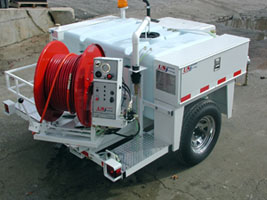
Encino is the hardest sewer work we do in the Valley, and it is hard for reasons that have nothing to do with the pipe material. It is the distance, the slope, the depth, and what is sitting on top of the trench. A Northridge or Reseda lateral is fifty or sixty feet of clay under a lawn. An Encino lateral can be two hundred feet of pipe running down a hillside driveway, twelve feet deep at the street, passing under a pool deck, a motor court and a protected coast live oak on the way.
BBC Rooter & Plumbing is a sewer, main drain and underground-pipe contractor — that is the entire business. We do not install water heaters, fixtures, water supply repiping or gas lines. What we do is diagnose and rebuild the buried line, and in Encino that specialization matters more than anywhere else in the Valley, because the cost of guessing wrong on a two-hundred-foot line under hardscape is measured in tens of thousands of dollars. Call 818-280-9135.
There Are Two Encinos, and They Fail Differently
Split the neighborhood at Ventura Boulevard and you have two effectively separate sewer environments.
North of the boulevard — 91316, the flats. Amestoy Estates, Encino Village, the grid running out toward Balboa, Hayvenhurst, Lindley and the Sepulveda Basin. This is valley alluvium, flat and sandy, with the water table climbing as you approach the basin and the river. Housing is mostly late-1940s through 1960s ranch, on generous 10,000 to 20,000 square foot lots. The pipe here is vitrified clay with mortared joints and cast iron at the building — the same materials as the rest of the Valley, but on much longer runs because the lots are so deep.
South of the boulevard — 91436, the hills. Valley Vista, Royal Oaks, Encino Hills, the streets climbing toward Mulholland and the Encino Reservoir. Here the ground is Modelo Formation shale and siltstone rather than river sand, most pads were cut-and-filled into the slope, and the sewer leaves the house at elevation and drops hard to reach a main that may be a hundred and fifty feet below and away. Estates from the 1960s through the 1980s, frequently with a guest house, pool equipment room or later ADU tied into the same single lateral.
Oaks, Sycamores and Why Trenching Is Rarely the Answer Here
Encino is named for its oaks — encino is Spanish for the evergreen oak — and the coast live oaks that gave the area its name are still standing over a lot of sewer trenches. That is a legal problem as much as a plumbing one. Mature native oaks, western sycamores and California black walnuts are protected under the City of Los Angeles Protected Tree Ordinance, and you cannot simply run an excavator through a protected root zone to reach a broken lateral.
The non-native planting is just as troublesome underground. Liquidambar — sweetgum — went into Encino parkways and front yards by the thousand during the 1960s, and its shallow, wide, opportunistic root system is one of the most reliable sources of joint intrusion we see. Deodar cedar, eucalyptus, Canary Island pine and old olive trees on the estate lots all contribute.
This is the single strongest argument for no-dig rehabilitation in Encino. Cured-in-place lining rebuilds the pipe from the inside and seals every joint the roots were using, with access from a cleanout and one small pit. Pipe bursting pulls a new continuous HDPE line along the old path. Neither one requires opening a protected root zone, a stamped-concrete motor court, a pool deck or a mature hedge line — all of which are common, expensive obstacles on Encino properties.
How Rancho Los Encinos Became a Neighborhood of Very Long Sewer Runs
The land was Rancho Los Encinos, granted in 1845 and centered on the natural springs that still run at Los Encinos State Historic Park on Moorpark Street, where the 1849 de la Osa Adobe and the 1872 Garnier building remain. Ranching gave way to subdivision after Encino was annexed into the City of Los Angeles in the mid-1910s and water arrived from the aqueduct.
The pattern of that subdivision is why the plumbing looks the way it does. Encino was carved out of large ranch holdings into large parcels — not the tight 6,000-foot postwar tract grid you find in Winnetka or Reseda. Deep lots north of the boulevard meant houses set far back from the street, and houses set far back mean long laterals. Then the 1960s through 1980s hillside build-out south of the boulevard added elevation and depth to the same problem.
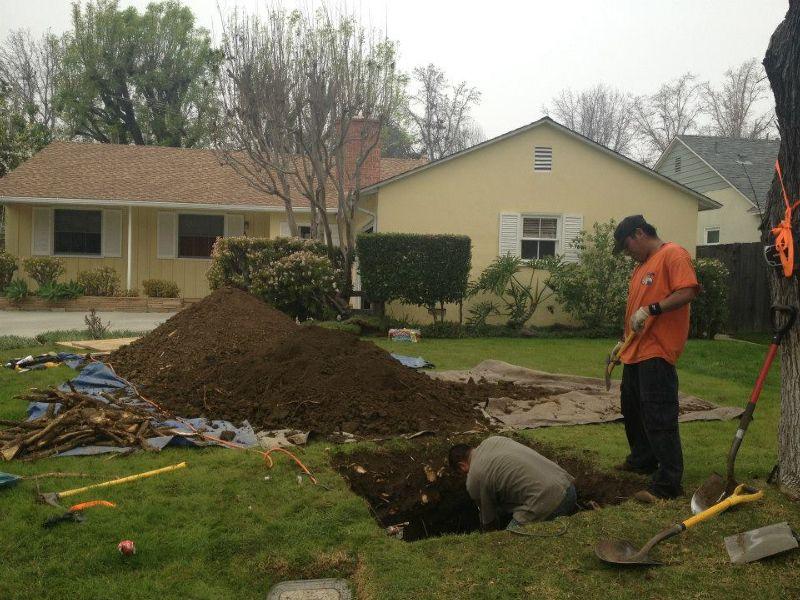
Length changes the failure mode
A hundred-foot-plus lateral has more joints, more opportunity for differential settlement, and more places for a belly to form. It is also beyond the comfortable reach of consumer-grade cable equipment, which is why so many Encino calls come to us after somebody else "cleared it" and the problem returned within days — the cable never got to the actual blockage.
On steep hillside runs there is a second effect: where a very steep section flattens out, liquid outruns the solids and drops them at the transition. That deposit builds until it dams the line. It is a grade problem, not a clog, and jetting relieves it while a camera survey tells you whether the grade itself needs correcting.
The Sewer Problems We Actually Find in Encino
Root intrusion under protected canopy
Oak, sycamore and liquidambar roots entering failed clay joints in the front-yard run. Cutting the tree is usually not permitted and rarely necessary — sealing the pipe is what stops the intrusion.
Storm-season infiltration on hillside lines
Cracked joints on a saturated slope let groundwater into the lateral. Homeowners describe backups that only happen after heavy rain, which is a strong indicator the pipe is open to the soil.
Abandoned seepage pits and old septic
Some older hillside properties were built before sewer mains reached the upper streets. We still find abandoned cesspools and orphaned lines that were never properly capped when the house was connected to the city system.
Under-slab cast iron on Ventura Boulevard
Commercial buildings along the boulevard from the 1950s and 1960s sit on cast-iron drainage that has corroded from the invert up. Combined with restaurant grease loading, it produces chronic backups no amount of cabling will resolve.
Multiple structures on one lateral
Guest houses, pool baths, cabanas and converted ADUs often tie into a single original 4-inch line sized for one household. The line is not defective — it is overloaded, and the tie-in points are where solids hang up.
Bellies under hardscape
Motor courts, pool decks and heavy paving compress the fill beneath them over decades, sagging the pipe below into a standing-water low spot that has to be jetted or re-graded.
Symptoms That Mean the Trouble Is Below the House, Not In It
Because Encino houses are large and the fixtures are spread out, a failing main line often looks like several unrelated small problems before anyone connects them. These are the patterns worth acting on:
- Backups that track the weather — slow drains or overflow that appear after storms and clear up in dry weeks point to groundwater entering a cracked line, especially in the hills
- The lowest fixture in the house floods first — typically a ground-floor guest bath or a pool-house shower on a split-level or hillside property
- Two wings of the house misbehaving at once — separate branches acting up together means the shared main downstream is the problem
- A depression or sinkhole in the motor court, lawn or driveway — soil migrating into a broken pipe, which on a slope can undermine hardscape quickly
- Sewer odor around a side yard or an old capped stub — frequently an abandoned line or an unsealed former septic connection
- Recurring failures after routine cable service — on a long Encino lateral this usually means the cable is not reaching the actual defect
The first move in every one of these cases is the same: put a camera down the line, locate and depth the defect from the surface, and decide what to do with real information. We show you the footage on the monitor while we run it, and you get a written scope before anything is dug, cut or lined.
Sewage Backing Up at Your Encino Property? We Dispatch Today.
Camera, jetting and trenchless crews across 91316 and 91436 — seven days a week, written estimate before work begins.
Call 818-280-9135Drain Cleaning in Encino: Why Reach and Access Decide the Job Here
Most drain cleaning calls we take in Encino are not really about the clog. They are about whether the machine can physically get to it. An Encino lateral is frequently the longest residential sewer run we work on anywhere in the Valley — Rancho Los Encinos-era lot depths mean 120, 160, sometimes over 200 feet from the house to the city connection. A standard drum machine carrying 100 feet of cable simply does not arrive at the defect. It arrives at 100 feet, meets nothing, and the homeowner is told the line is clear. Two weeks later it backs up again. When we quote main line drain cleaning in Encino we size the machine to the measured run, and if the footage suggests we are working past the reach of a cable at all, we jet it instead.
The second Encino-specific problem is which opening we enter from. Large lots here often carry more than one structure on a single original four-inch line — a guest house, a pool bath, a converted garage or ADU, sometimes all three, all tied into a lateral sized for one household in the 1950s. When that line stops, the blockage is very often sitting at or just downstream of a tie-in rather than out in the main run. Entering from the wrong cleanout means cabling the healthy half of the system. We locate the cleanouts first, including the ones that have been paved over or buried under decades of landscaping, and we pick the access point based on where the fixtures that are backing up actually drain to.
What is in the pipe differs sharply between the two halves of Encino. North of Ventura Boulevard, on the flatter ground toward the Sepulveda Basin, the grade is shallow and the failure is settled solids and root intrusion at clay joints — a cable with the right cutting head handles it, and a camera afterward tells you whether the roots came from a joint that is about to need lining. South of the Boulevard in 91436, the line drops steeply off the hillside and then flattens abruptly where it reaches the street. Velocity collapses at that transition and material drops out of suspension there over and over. Cabling that spot buys you months. Jetting scours it properly, and if the camera shows the flat section has sagged into a true belly, no amount of cleaning of any kind is a permanent answer — that is a grade problem and it needs a repair.
On the commercial side, the Ventura Boulevard corridor through Encino is grease, not roots. Restaurant branch lines and older cast-iron building drains coat internally until the effective diameter is a fraction of what the plans say. Cable punches a hole through grease and the hole closes. Jetting at working pressure with the correct nozzle strips the wall back to pipe. For food service tenants we would rather put the line on a schedule than answer an emergency during dinner service. One point worth stating plainly, because we get asked: we clear main lines, building drains and sewer laterals — the stoppages that back up multiple fixtures at once. We do not do fixture work, water heaters or supply piping. Sewers and underground pipe are the whole of what this company does.
Our Encino Sewer Services
All of this is performed in-house by our own crews, residential and commercial:
Also in scope: underground pipe repair and excavation, collapsed and offset section replacement, belly correction, root intrusion removal, sewer gas diagnosis, cast iron and clay lateral replacement, abandoned line and seepage pit capping, and commercial sewer rehabilitation. Not in scope, ever: water heaters, tankless units, fixtures, disposals, water supply repiping, softeners, gas piping or new construction plumbing.
Encino Coverage, Sepulveda Basin to Mulholland
We work the whole of both Encino ZIP codes: the Amestoy Estates and Encino Village blocks north of Ventura Boulevard, the Balboa, White Oak, Hayvenhurst, Louise and Lindley corridors, the Moorpark and Burbank Boulevard streets edging the Sepulveda Basin, the boulevard commercial frontage, and the hillside streets south of Ventura through Valley Vista and Royal Oaks up toward the Encino Reservoir and Mulholland Drive.
Questions Encino Property Owners Ask Us
Our hillside house only backs up after heavy rain. Why would weather matter?
Because the pipe is open to the soil. When a lateral has cracked joints or fractured sections and the slope above it saturates, groundwater infiltrates the line and adds volume the pipe was never carrying before — enough to push a partially restricted line over capacity. It is a classic 91436 pattern and a reliable sign of structural defects rather than a simple clog. A camera run during or shortly after wet weather will often show water entering the pipe on video.
There is a large protected oak directly over our sewer line. Can it be repaired without touching the tree?
Yes, and that is exactly the situation trenchless methods exist for. Cured-in-place lining rebuilds the lateral from the inside with no excavation through the root zone, and pipe bursting replaces it along the existing path with access pits placed outside the canopy. We plan the pit locations around the protected root zone. Removing a mature native oak in the City of Los Angeles is a permitting exercise you do not want to start over a sewer repair, and in nearly all cases you do not have to.
Does a two-hundred-foot lateral cost more than a sixty-foot one?
Yes — length, depth and access are the three biggest cost drivers on any Encino job, and hillside properties tend to be unfavorable on all three. What we can tell you is that we will not quote a number before we have seen the footage. The camera tells us how much of the line is actually bad, and it is very common for a long Encino lateral to need one or two spot repairs rather than a full replacement. That distinction is worth thousands, and it is the reason the inspection comes first.
We are in escrow on an Encino property. What should the sewer inspection cover?
The full length of the lateral from the house to the connection at the city main — not just the first thirty feet. On these lots the expensive defects are usually out near the street, past where a quick look ends. You should receive video of the entire run, identification of the pipe material, notes on joint condition, root intrusion and bellies, and a surface-located depth for anything that needs repair. We provide all of that in a written report you can use in negotiations.
Do you handle restaurants and commercial buildings on Ventura Boulevard?
We do. Boulevard food service is grease-driven: interceptors that are undersized or overdue, FOG-coated branch lines, and older cast-iron building drains that have lost their invert. We run scheduled jetting and interceptor maintenance so kitchens stop having emergencies during service hours, and we handle full commercial sewer rehabilitation when the building drain itself is finished. Off-hours scheduling is normal for us.
Our hillside house was originally on septic. Is the old system still buried out there?
Often, yes. Properties built up the slope before sewer mains were extended to the upper streets had septic tanks and seepage pits, and when the house was later connected to the city system the old tank was not always properly abandoned. We locate these with the camera and by tracing the abandoned line, and we can cap and abandon them correctly. An unsealed old pit is both an odor source and a settlement risk under a driveway or slab.
How do I know whether I need main line drain cleaning or just a clogged fixture cleared?
The test is how many fixtures are involved and which one goes first. A single slow sink or tub is a branch-line or fixture issue. A main line stoppage shows up in more than one place at once, and it shows up at the lowest opening in the house first — a downstairs shower or a floor drain filling when a toilet is flushed or the washing machine discharges. Gurgling in a toilet when a different fixture drains is the same signal: air being pushed back through the trap because the main cannot take the volume. Main lines, building drains and sewer laterals are what we clear. If it is genuinely one fixture, a general plumber is the right call and we will tell you so on the phone.
Will drain cleaning fix an Encino line permanently, or am I going to be calling again?
It depends entirely on why it stopped, which is why we camera the line after we clear it rather than leaving at the moment flow returns. Grease and settled solids clear and stay clear if the cause is addressed. Roots come back, because the opening they entered through is still there — cleaning buys you a season or two and lining the joint ends it. A belly refills every time, because the pipe is holding water by design at that point. On a long Encino lateral the honest answer is usually visible on the monitor within a few minutes of the camera going in, and we would rather show you that than sell you the same cleaning twice a year.
Other San Fernando Valley Areas We Serve
Encino sits on our southern edge, between Tarzana and Sherman Oaks. We cover the full Valley and parts of greater Los Angeles:
A Contractor Who Does Nothing But Sewers
BBC Rooter & Plumbing — owner Babak Behzadi, CSLB #720343, based at 8635 Yolanda Ave #6, Northridge. Open 7 days, 6am to 6pm.
Call 818-280-9135