_1773179633783-DiqUK4T2.png)
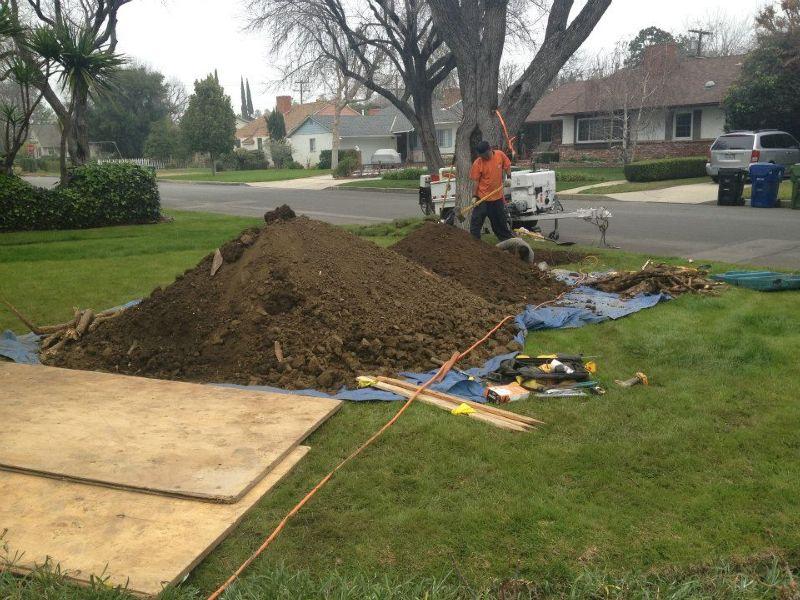
BBC Rooter & Plumbing is headquartered in Northridge at 8635 Yolanda Ave #6, 91324. Owner Babak Behzadi built the company here, and the majority of the sewer laterals our crews have opened, scoped, jetted, lined and replaced over the years sit under Northridge streets. That matters more than it sounds. A sewer company that works a city every single day stops guessing: we already know which tracts were plumbed in vitrified clay, which blocks have city mains deep enough to require a longer bursting pull, and which parkway trees on which streets are responsible for most of the root calls.
Everything below is specific to Northridge — the ground under it, the decades it was built in, what the 1994 earthquake left behind in the pipe, and how we approach a job here. If your line is backing up right now, skip the reading and call 818-280-9135. Someone answers, and we are open seven days a week, 6am to 6pm.
Why Our Trucks Start the Day on Yolanda Avenue
Our shop sits on Yolanda Avenue a few blocks off Nordhoff Street, roughly in the middle of the 91324 ZIP. From that yard, almost every Northridge address — the tracts north of Devonshire, the streets around the CSUN campus, the blocks behind the Northridge Fashion Center, the older large-lot properties off Zelzah — is a short drive with no freeway involved. That is why we can usually put a truck in front of a Northridge house within about half an hour to an hour on an emergency backup, and why we can come back the next morning to re-scope a line without treating it as a whole new dispatch.
Being based here also changes what is on the truck. We stock cured-in-place liner in the diameters Northridge laterals actually are, bursting heads sized for four-inch and six-inch clay, sectional cable machines for interior branch lines, and a trailer jetter for main lines and commercial grease runs. On a job that turns out to need more than a cable, we are not scheduling a second visit a week out to fetch equipment from across town.
What the 1994 Earthquake Did to Northridge Sewer Laterals
On January 17, 1994, a blind thrust fault ruptured under the Valley floor. The quake carries Northridge's name, and while the instrumented epicenter was actually just south of here beneath Reseda, the strongest ground motion recorded anywhere in that event hit this side of the Valley. Buildings were retrofitted. Freeway spans were rebuilt. Almost nobody went back and looked at the buried clay pipe.
Vitrified clay sewer pipe is strong in compression and brittle in everything else. A four-inch lateral is a chain of short sections joined every two to three feet, and in pre-1970 Northridge construction those joints are packed with mortar or oakum rather than a modern rubber gasket. When the ground moved, the pipe could not flex with it. What we find on camera thirty years later is a signature pattern: joints that have pulled apart or stepped out of round, hairline cracks running around the circumference of a section rather than along its length, and short reaches where the pipe has settled out of grade relative to the run on either side.
Very little of that failed the day of the quake. It failed slowly. An offset joint leaks a small amount of moisture into the surrounding soil, roots find the vapor plume, the roots enlarge the opening, paper and solids catch on the root mass, and eight or fifteen or twenty-five years later a homeowner calls because the tub is filling up when the washing machine drains. When we scope a Northridge line and see stair-stepped offsets at multiple joints in the same reach, that is usually seismic displacement, not a single failure point — and it is the reason a spot repair in Northridge sometimes buys less time than owners expect. If the whole run has been shifted, lining or replacing the whole run is the honest recommendation.
How we prove it instead of assuming it
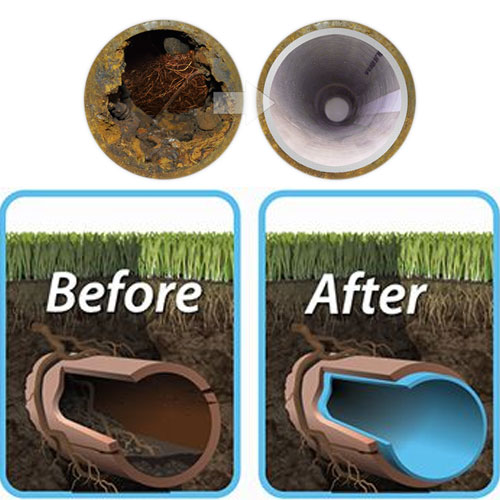
We do not price seismic damage off the build year. We run a self-leveling camera with a sonde through the line from the cleanout, mark the depth and position of every defect on the surface with a locator, and hand you the footage. If the pipe is intact and the problem is a grease plug or a root ball at one joint, we say so and we clean it.
When the run genuinely is compromised, trenchless rehabilitation usually rebuilds it from inside the existing pipe with two small access pits instead of a trench across the front yard.
Reading a Northridge Address: Build Year, Pipe Material, Likely Failure
Northridge started as Zelzah, a stop on the Southern Pacific line in 1908, sitting in wheat, walnut and citrus country. It was renamed in the late 1930s, and the community that exists today was mostly poured between the end of the Second World War and the early 1970s, with San Fernando Valley State College — now CSUN — opening in 1958 and pulling housing, apartments and retail in behind it. That timeline maps almost directly onto what is buried in the ground.
- Pre-1950 properties, including the surviving large-lot and horse-keeping parcels in the north end of Northridge: clay laterals, often shallow, sometimes hand-dug on a grade that was fine when the yard was flat and is not fine after seventy years of settlement and landscaping.
- 1950s and early 1960s tract houses, the bulk of the housing stock: four-inch vitrified clay from the house to the city main, mortared joints, with a cast iron building drain under the slab or in the crawlspace.
- Mid-1960s through the 1970s: more cast iron, and this is the material now hitting the end of its service life. Cast iron does not usually crack first — it scales and channels from the inside, so the effective diameter shrinks year over year and the invert erodes into a rough trough that catches everything.
- Scattered 1950s and 1960s installations used Orangeburg, a bituminized fiber conduit that was cheap and legal at the time. It does not crack, it deforms. It goes oval, then flattens, then collapses. There is no repairing it, only replacing it.
- Late 1970s onward: ABS and PVC. These lines rarely fail on their own. When they do, it is a crushed section from vehicle load, a bad joint, or a belly created by poor bedding at installation.
Knowing the material before work starts is not academic. It decides whether the right answer is a root-cutting jetter pass, a cured-in-place liner, a pipe burst, or an open-cut repair — and it decides the price. We identify it on camera before quoting.
Street Trees Along Reseda Blvd, Zelzah and Lindley, and the Roots Underneath
Northridge has a genuinely mature urban canopy, and the species that were planted in the parkways during the postwar build-out are the same species that fill sewer laterals. Ficus, planted heavily along commercial stretches including Reseda Boulevard, is the worst offender in the Valley: fast, shallow, aggressive, and capable of lifting sidewalk panels and finding a hairline joint at the same time. Southern magnolia, California pepper, liquidambar and the older camphor and carob plantings on residential streets between Devonshire, Nordhoff and Parthenia all send feeder roots toward any consistent source of moisture.
The mechanism is worth understanding because it changes the fix. Roots do not attack sound pipe. They follow humidity. A joint that weeps a little warm water into dry soil is a beacon, and once a hair-thin root enters, it thickens inside the pipe where there is water and nutrient and no competition. By the time a homeowner notices anything, the mass is frequently blocking a third to half the pipe.
Cutting the roots out with a cable or a rotating jetter nozzle restores flow immediately. It does not close the door they came through, which is why the same house calls again on roughly the same interval. And in Northridge you usually cannot solve it at the tree, because parkway trees belong to the City of Los Angeles and cannot be removed at a homeowner's discretion. The durable fix is to take the joint away: line the reach so there is no opening for the root to re-enter, or replace it. We will tell you plainly which of the two your line justifies.
CSUN Rentals, Fourplexes and Commercial Blocks
Northridge is not all owner-occupied ranch houses. The blocks around the university — Nordhoff, Lindley, Zelzah, Halsted, Prairie — carry a dense layer of student rentals, duplexes and 1960s and 1970s apartment buildings, and the retail corridors near Tampa and Plummer and around the Fashion Center carry restaurants, markets and medical offices. Those properties fail differently than single-family homes.
One lateral, twelve tenants
An older Northridge fourplex or eight-unit building usually drains into a single main line to the street. Peak load lands all at once, and the line has no recovery window. These buildings do far better on scheduled hydrojetting than on emergency calls.
Wipes and paper load in rentals
Turnover means constant new occupants who do not know the building. So-called flushable wipes do not break down, and they knit into the roughened invert of old cast iron. We pull them out of rental main lines here weekly.
Grease from food service
Restaurants near the Fashion Center and along Tampa and Reseda accumulate fats, oils and grease that harden into the kitchen line and the building lateral. Interceptor service plus periodic jetting keeps it from becoming a shutdown.
For managers and owners we can work around occupancy: after-hours and early-morning appointments, a written scope before anyone touches anything, and the camera footage delivered as a file you can forward to an owner, a board or an insurer.
The Sewer Work We Do at Northridge Addresses
Every one of these is performed by our own crews. We do not subcontract sewer work out and then mark it up.
Alongside that we handle root intrusion removal, collapsed, bellied and offset lateral repair, underground pipe excavation, cast iron, clay and Orangeburg replacement, sewer gas diagnosis, pre-purchase sewer scopes, and commercial sewer rehabilitation.
What we do not do: we are a sewer and underground-pipe company only. Water heaters, tankless units, faucets, toilets, sinks, disposals and other fixtures, water supply repiping, copper pinhole leaks, water softeners, gas lines and new-construction plumbing are outside our scope. If that is what you need, we will tell you on the phone rather than sending a truck.
Pipe Bursting on Northridge Laterals: When the Old Pipe Is Too Far Gone to Line
Homeowners here often call asking for trenchless work generally and then find out the two trenchless methods are not interchangeable. On Northridge addresses the answer swings toward pipe bursting more often than it does elsewhere in the Valley, and the reason is under the ground rather than in the sales pitch.
A cured-in-place liner is formed inside the pipe you already have. That requires a host pipe that is still round and still continuous. Bursting requires neither. A bursting head is pulled through the old lateral on a cable, it splits the original pipe outward into the surrounding soil, and a new seamless HDPE pipe follows directly behind it along the same alignment. The excavation is a launch pit at one end and a receiving pit at the other, not a trench between them.
That distinction matters at this zip code because of what January 1994 did to the ground. Ground deformation displaces pipe at its weakest point, which on a clay lateral is the joint. Displacement is exactly the defect a liner cannot bridge: at an offset joint the liner has no continuous wall to press against, and it will either fail to pass or cure into a stepped, snag-prone bore that catches paper for the next thirty years. On a lateral where the camera shows several separated joints along a single run — a pattern we see constantly on the older tract streets around the shop — bursting the whole run and pulling new pipe is the honest recommendation, and it is usually the cheaper one over any horizon longer than a couple of years.
Bursting also solves a problem specific to older clay and Orangeburg laterals: capacity. A liner leaves you slightly smaller inside than you started, since the liner wall occupies part of the bore. A burst can pull in the same nominal size or go up a size, which on a Northridge fourplex or a converted CSUN rental with several units on one lateral is the difference between a line that keeps up and a line that backs up every time three showers run at once.
What decides it is the camera, not a preference. We scope the lateral, mark the defects on the surface by footage and depth, and then say which method the pipe actually supports. Both are permitted work in the City of Los Angeles, both get inspected, and both are quoted in writing before a machine is unloaded on your driveway.
Booking a Northridge Sewer Call Today
Camera inspection included with repair work. Written estimate before anything gets cut or dug.
Call 818-280-9135Northridge Coverage Map
We cover 91324, 91325, 91326 and 91330 in full, including the Devonshire Highlands and Lassen Heights areas, the horse-keeping properties in the north end, the CSUN campus perimeter, the Fashion Center district, and the residential grid bounded roughly by Roscoe, Devonshire, Balboa and Corbin.
Questions Northridge Homeowners Ask Us
My house is a 1960s Northridge ranch. Is the sewer line clay or cast iron?
In most 1960s Northridge tract houses the building drain under the house is cast iron and the lateral running out to the city main in the street is vitrified clay, though there are plenty of exceptions on both counts. The only way to know for certain is a camera inspection, which also tells us the diameter, the depth, and whether the joints have shifted. We will not quote a repair method before we have seen the material.
Does 1994 earthquake damage to a sewer line still show up on camera today?
Yes, and we still find it regularly in Northridge. It appears as offset joints where one pipe section has stepped out of alignment with the next, cracks that run around the pipe rather than along it, and reaches that have settled out of grade. Most of that damage did not cause an immediate backup. It opened the pipe to roots and groundwater, and the failure showed up years or decades later.
Who is responsible for the sewer pipe under the street in Northridge, me or the City?
In the City of Los Angeles the property owner is responsible for the house connection sewer, which is the lateral from the building all the way to the point where it ties into the City main, including the portion buried in the street or parkway. The City maintains the main itself. That is why a failure out under the curb is still the homeowner's repair, and why work in the public right of way needs the proper permits, which we pull.
Can you line a Northridge sewer lateral without digging up my driveway?
Usually, yes. Cured-in-place lining and pipe bursting both work from small access points rather than a continuous open trench, so concrete driveways, mature landscaping and hardscape typically stay intact. The exceptions are a fully collapsed pipe, a severe belly that has to be re-graded, or a line so far out of round that no liner can be pulled through. We identify those on camera first and tell you before you commit.
How fast can you reach a Northridge address for an active backup?
Our shop is on Yolanda Avenue in Northridge, so for most Northridge addresses we are typically 30 to 60 minutes out during our operating hours, seven days a week from 6am to 6pm. Call 818-280-9135 and describe what is happening, and we will tell you honestly what the arrival window looks like that day.
Neighboring Valley Cities We Cover
Northridge is our base, but our service radius takes in the whole San Fernando Valley and parts of greater Los Angeles:
Your Northridge Neighbors' Sewer Company
BBC Rooter & Plumbing, 8635 Yolanda Ave #6. Licensed CSLB #720343, owner-operated, open seven days.
Call 818-280-9135