_1773179633783-DiqUK4T2.png)
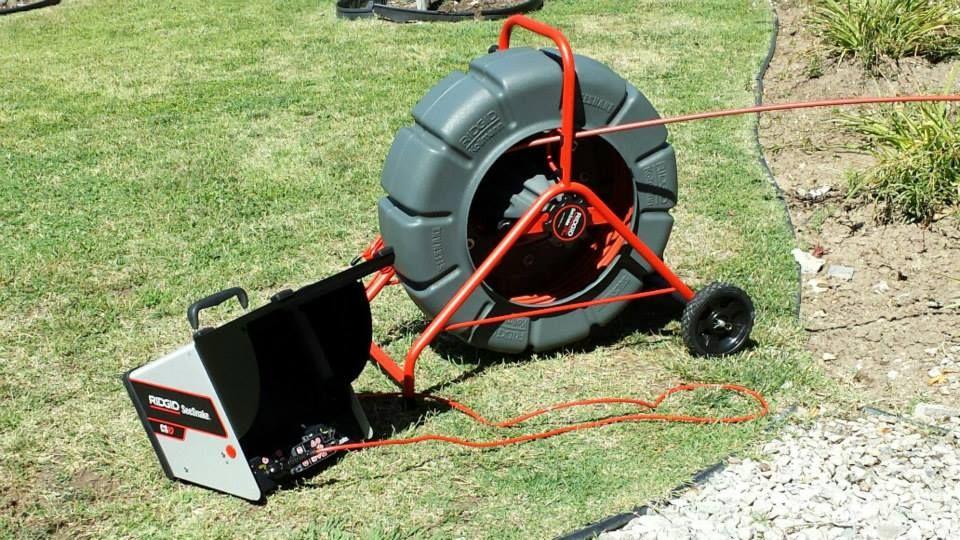
BBC Rooter & Plumbing handles sewer lines, underground pipe and main drains across Tarzana, from the apartment blocks and 1950s tracts up near Victory and Oxnard down through the Ventura Boulevard commercial strip and into the canyon streets on the south slope. Different ground, different pipe, different access problems — and a quote that reflects which one you are actually on.
Active backup or standing sewage? Call 818-280-9135. We answer seven days a week and dispatch from Northridge.
Tarzana Splits in Two at Ventura Boulevard
Almost every sewer decision in Tarzana starts with one question: are you north of the Boulevard or south of it?
North of Ventura is Valley floor. Alluvial soil, gentle grade, a regular street grid running out toward Oxnard, Burbank Boulevard and Victory, and housing that is mostly postwar tract and a layer of apartment and condo development from the 1960s and 1970s. Sewer laterals up here are short to moderate, reasonably shallow, and the failure pattern is the standard Valley one: clay joints, roots, scale in cast iron, the occasional belly.
South of Ventura is the north face of the Santa Monica Mountains. The streets bend and climb, the lots get larger and less regular, the houses sit well back or well above the road, and the sewer lateral may be a hundred and fifty feet of pipe running down a slope through sedimentary rock, engineered fill and slide-prone colluvium before it ever reaches a main. Everything about a hillside job — access, equipment, method, cost — is different from the same nominal job three blocks north.
When we quote Tarzana work we look at the parcel first. Two houses with the same square footage and the same age can be entirely different jobs depending on which side of the Boulevard they sit on.
From Burroughs' Ranch to Today's Lot Lines
Tarzana exists because of a novelist. In 1919 Edgar Rice Burroughs, by then wealthy from the Tarzan books, bought the former Mil Flores ranch of Los Angeles Times publisher Harrison Gray Otis, in the hills and flats on the south side of the Valley, and renamed it Tarzana Ranch. He subdivided pieces of it through the 1920s, and the community that grew around the property took the Tarzana name by the end of that decade.
That origin story is written into the ground in a way that matters to a sewer contractor. Because Tarzana was carved out of one large ranch rather than laid out as a single uniform tract, the parcel sizes are inconsistent and the build-out happened in waves:
- 1920s and 1930s ranch-era homes on generous, irregular parcels, some with original clay laterals that were extended or re-routed during later remodels — which means the line in the ground may not follow the path anyone assumes.
- Late 1940s through the 1950s: the main postwar fill-in north of Ventura, four-inch vitrified clay to the street, cast iron building drains.
- 1960s and 1970s: apartment and condominium development in the flats, plus the first serious push of custom homes up the south slope, still largely clay and cast iron.
- 1980s onward: ABS and PVC on hillside rebuilds and infill, generally sound pipe whose problems come from bad bedding, crushing under vehicle load, or joints that were never properly solvent-welded.
Because so many Tarzana properties have been remodeled, added onto or rebuilt on the original footprint, we treat the recorded plumbing layout as a hypothesis and confirm the real route with a camera and a sonde locator before we plan any excavation.
Long runs favor no-dig methods
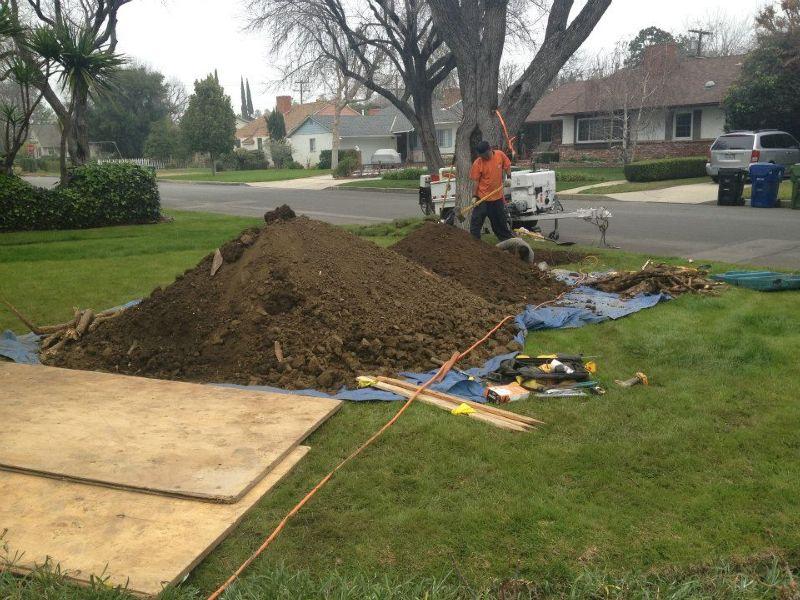
A hundred-and-fifty-foot lateral crossing a motor court, a pool deck and a terraced garden is the worst possible candidate for open trenching and one of the best candidates for pipe lining or pipe bursting.
We can typically rehabilitate a long Tarzana run from an access pit at each end, leaving the surface between them untouched.
Hillside Laterals South of the Boulevard
People assume a steep sewer line cannot clog because gravity does the work. In practice the hillside lines above Ventura Boulevard bring us a specific set of problems that flat-lot lines do not.
Too much fall, not enough water
When a lateral drops far more steeply than the quarter-inch-per-foot design fall, liquid can outrun the solids it is supposed to carry. Paper and waste get left behind on the steep reach and accumulate where the grade flattens out near the street.
Downhill houses take the backup
If a shared or downstream line surcharges, the lowest fixture on the lowest property is where it surfaces. On hillside Tarzana lots that is often a garage floor drain or a lower-level bathroom. A properly specified backwater valve is the defence.
Rock, fill and access
The south slope is sedimentary rock with pockets of engineered fill and loose colluvium. Excavation is slower, sometimes hand-dug, and a truck frequently cannot get close to the work, so equipment has to be walked in.
Pipe bursting works by displacing the surrounding soil as the new pipe is pulled through, so it is a strong option in fill and softer ground and a poor one where the line is bedded in solid rock. Lining does not care about the surrounding material, only about the condition and shape of the host pipe. We choose between them on evidence from the camera, not on a preference.
Oaks, Sycamores and Root Intrusion on Big Tarzana Lots
Tarzana keeps a lot of its old trees, especially south of the Boulevard and on the larger parcels north of it. Coast live oak, western sycamore, California black walnut and toyon are protected species under the City of Los Angeles protected tree ordinance, which means a mature specimen on your property is not something you can simply have removed because it is inconvenient for your plumbing.
That constraint shapes the repair. An oak that has found a leaking clay joint will keep finding it: cutting the roots with a cable or a rotating jetter nozzle restores flow and buys time, but the entry point is still open and the tree is still there and still thirsty. Chemical root treatments are a poor answer next to a protected tree and we do not push them.
The approach that actually holds is to remove the opportunity rather than the tree. A cured-in-place liner seals the joints across the affected reach so there is nothing for a root to enter, and it does it without trenching through the root zone — which matters, because a trench across a protected oak's critical root zone can do the tree more harm than the roots were doing the pipe. Where a run is too deformed to line, we plan the excavation with the tree's drip line in mind and, on larger properties, we are used to coordinating with an arborist and with permit conditions.
Ventura Boulevard Restaurants and Grease Line Maintenance
The Ventura Boulevard corridor through Tarzana is a continuous commercial strip: restaurants, cafes, markets, medical and dental offices, gyms and small retail, much of it in buildings that have changed use several times. Kitchens installed into spaces that were never planned for food service are common, and the drainage often reflects that.
Fats, oils and grease are the whole story on these lines. Grease leaves the sink liquid and hardens on the pipe wall as it cools, thickening until the line is a fraction of its rated diameter. Cabling a grease line bores a hole through the deposit and leaves the rest in place, so it re-blocks quickly. High-pressure jetting with a de-scaling nozzle strips the wall back toward bare pipe, and grease interceptor service on a fixed interval keeps the load out of the building lateral in the first place.
We schedule Tarzana food-service work around trading hours — before opening, after close, or on a slow weekday — and we provide the camera footage and written records that a landlord, a franchisor or a health inspection may require.
Buying or Selling in Tarzana? Scope the Line First
A sewer lateral is one of the few major systems in a house that a standard home inspection does not look inside. On a Tarzana property that can be a five-figure blind spot, because the lateral may be long, deep, on a slope, under a pool deck, or original to a 1950s or earlier build.
A pre-purchase sewer camera inspection answers, in about an hour, what a buyer actually needs to know:
- What material the lateral is, and how much service life that material realistically has left
- Whether there are root masses, offsets, cracks, bellies or previous repairs, and exactly where along the run
- How deep the line is and what is built above it, which drives the cost of any future repair
- Whether the line even runs where the plans say it does, which on a remodeled Tarzana property is not a given
- Whether a defect is a maintenance item or a replacement, so it can be negotiated with real numbers rather than a guess
We provide the recorded video and a written summary you can hand to your agent, the other side, or an escrow officer. We work to escrow timelines and we are equally willing to tell a buyer that the line is fine.
Drain Cleaning in Tarzana: Finding the Cleanout Is Half the Work
Before anyone talks about machines, a Tarzana drain cleaning call usually starts with a hunt. The postwar tract blocks north of Ventura Boulevard — the streets that filled in around Reseda Boulevard and Clark after the Burroughs ranch was subdivided — were built with the main line cleanout at the front of the house or out near the property line, and in seventy years a great many of those have disappeared. They have been paved into a driveway extension, buried under a raised planter, sealed behind a stucco patch when a porch was enclosed, or capped and forgotten during a remodel. Some houses on these blocks never had an accessible one to begin with. We carry a locator for exactly this reason, and finding the proper opening is the difference between cleaning the sewer line and pulling a toilet to get at it.
The next question is which line is actually stopped, and it is worth knowing the answer before you call anyone. A single fixture draining slowly is a branch problem. A main line stoppage announces itself differently: several fixtures go at once, and the trouble appears at the lowest opening in the house first. A shower that fills when a toilet is flushed, a toilet that gurgles when the washing machine dumps, a floor drain that surfaces during a laundry cycle — those are all the main line telling you it cannot take the volume. Main lines, building drains and sewer laterals are what this company clears. Fixtures, water heaters and supply piping are not, and if what you describe on the phone sounds like one fixture we will say so rather than roll a truck.
Once we are in the line, Tarzana tends to hand us one of three things. On the flat blocks north of the Boulevard it is roots, almost always from the parkway trees the tract was planted with, entering four-inch clay at the joints in the front-yard run — a cutting head clears it and the camera afterward tells you whether that joint is a candidate for lining. South of the Boulevard, up the slope toward Mulholland, the laterals are long and the machine's own torque becomes the limit; a cable that turns confidently at sixty feet is doing very little useful work at a hundred and fifty, which is where a jetter earns its place. And along the Boulevard itself, in the restaurant and retail stretch, it is grease and hardened scale in cast iron, where cabling opens a channel that closes again within weeks.
The part we insist on is looking afterward. Restoring flow is not the same as knowing why flow stopped, and on a line old enough to be clay or cast iron those are frequently different stories. We would rather run the camera, show you the footage on the monitor while it happens, and tell you honestly whether you are looking at seasonal maintenance, one bad joint that should be lined, or a sagged section that will refill no matter how many times it is cleaned. Selling the same cleaning to the same house twice a year is not a business we are interested in being in.
Sewer Services Available at Tarzana Properties
We also carry out underground pipe excavation, collapsed and offset lateral repair, root intrusion removal, clay, cast iron and Orangeburg replacement, sewer gas diagnosis, backwater valve installation and commercial sewer rehabilitation.
Not our trade, and we will say so up front: water heaters and tankless systems, faucets, toilets, sinks and disposals, water supply repiping, pinhole copper leaks, water softening and filtration, gas lines and new-construction plumbing. We are underground and sewer only.
Sewer Trouble in Tarzana Today?
Written estimate before work begins, camera evidence for every recommendation.
Call 818-280-9135Where Tarzana Sits on Our Map
We cover 91356 and the Tarzana portions of 91335 and 91357: the flats between Victory, Oxnard and Burbank Boulevard, the Reseda Boulevard and Tampa Avenue corridors, the Ventura Boulevard commercial strip, the medical district around Clark Street, and the hillside streets climbing south toward Mulholland Drive.
What Tarzana Property Owners Ask
My house is on a slope south of Ventura Boulevard. Does that make sewer repair harder?
It makes it different rather than automatically worse. Hillside work involves longer pipe runs, deeper and sometimes rocky excavation, and access limits when a truck cannot park near the work, so equipment has to be brought in on foot. On the other hand a long run through finished landscaping is exactly where trenchless lining earns its keep, because we can rebuild the pipe from two small pits instead of trenching the whole slope. We walk the property before quoting so the estimate reflects the real conditions.
There is a protected oak growing over my sewer line. Can you still clear the roots?
Yes. We can cut roots out of the pipe mechanically or with a jetter without touching the tree, which restores flow right away. The catch is that the crack or open joint the roots came through is still there, so they will return. The lasting fix is usually to line that reach so the pipe has no openings, which also avoids trenching through the root zone of a tree that is protected under the City of Los Angeles tree ordinance and cannot simply be removed.
Should I get a sewer camera inspection before buying a Tarzana home?
We think so, particularly on anything built before about 1980 or on a hillside lot. A standard home inspection does not put a camera inside the sewer lateral, and the lateral is the single most expensive buried system on the property. An hour of camera work tells you the pipe material, its condition, its depth, its actual route, and whether you are looking at routine maintenance or a major replacement. You get the video and a written summary to use in negotiation.
Can you replace a long sewer lateral without trenching the whole driveway?
In most cases yes. Pipe bursting pulls a new pipe through the path of the old one from access pits at each end, and cured-in-place lining rebuilds the existing pipe from the inside, so the surface in between stays intact. The situations that force open excavation are a fully collapsed line, a belly that has to be re-graded, a change in pipe route, or ground so rocky that bursting cannot displace the surrounding material. We determine which case applies from the camera inspection before you commit to anything.
Do you service Ventura Boulevard restaurants before opening hours?
Yes. Grease line jetting and interceptor service on the Tarzana stretch of Ventura Boulevard is normally done early in the morning before service or late after closing, because it is not practical to work a kitchen line while food is going out. We can also put the line on a fixed maintenance interval so it stops becoming an emergency.
I cannot find a sewer cleanout at my Tarzana house. Can you still clear the main line?
Almost always, yes. Missing or buried cleanouts are common on the older Tarzana tracts, and we carry locating equipment to find one that has been paved over, planted over or stuccoed shut rather than guessing. If the property genuinely does not have an accessible cleanout, we can work through a roof vent or pull a toilet to get access, and we will usually recommend installing a proper two-way cleanout afterward. It is a modest job that makes every future service call faster, cheaper and far less invasive than the alternative.
How much does drain cleaning cost in Tarzana, and does a camera inspection cost extra?
We do not publish a flat rate because the honest cost depends on the access we find, the length of the run and what is in the pipe — a front-yard root cut on a sixty-foot clay lateral and a jetting job on a hundred-and-eighty-foot hillside run are not the same work. What we can commit to is that you get a price before we start, not after, and there is no premium for a weekend or an evening; we are open seven days, six to six, and the rate is the rate. When a camera run is warranted we quote it up front as well, and on a line we have just cleared it is usually the most valuable hour you can spend, because it is what separates a problem that is finished from one that is coming back.
More Valley Communities on Our Route
Beyond Tarzana we cover the full San Fernando Valley and neighbouring parts of Los Angeles:
Tarzana's Sewer and Underground Pipe Specialist
BBC Rooter & Plumbing — CSLB #720343, owner-operated, open seven days a week.
Call 818-280-9135