_1773179633783-DiqUK4T2.png)
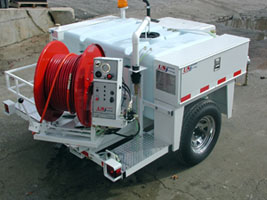
Porter Ranch is the odd one out among the neighborhoods we cover. Almost everywhere else in the San Fernando Valley we are dealing with pipe that was buried before the Kennedy administration. Here, most of the housing went up between the late 1980s and the mid 2000s on land graded out of the Santa Susana foothills, and the sewer lateral under a typical Porter Ranch house is plastic, not clay and not cast iron.
Owners take that to mean the sewer is a solved problem. It is not. It means the problems are different ones, and diagnosing them takes a camera and some knowledge of how this particular hillside was built rather than a guess based on the year the house was finished. BBC Rooter & Plumbing does sewer, main drain and underground pipe work exclusively, we run out of Northridge, and Porter Ranch is a twenty minute drive up Tampa or Corbin. If a line is stopped right now, call 818-280-9135.
Newer Pipe, Newer Set of Problems
The drain and waste piping in a Porter Ranch tract home is generally ABS — the black plastic that replaced cast iron in California residential construction — running to a PVC lateral out to the street. Plastic does not corrode, does not scale, and does not care about the chemicals that eat metal. Nothing we say here should be read as plastic being a bad material; it is a far better sewer pipe than anything that came before it.
What plastic is sensitive to is installation and support. A plastic lateral is only as straight as the bedding it was laid on, and it depends entirely on solvent-welded joints that were made correctly on a busy tract site, sometimes in weather, sometimes by whoever was available that afternoon. There is also a specific historical wrinkle here: some ABS drain pipe manufactured in the mid-to-late 1980s became the subject of a widely documented cracking problem, and that production window overlaps the first wave of building in this part of the north Valley. It is not a reason to panic. It is a reason that a camera, not the construction date, decides whether a Porter Ranch line is healthy.
Building on Cut and Fill: Where Porter Ranch Laterals Move
These hillside pads were not found flat. They were made flat, by cutting into the slope and using the excavated material to build up the low side. That is completely standard engineering practice and the pads themselves are compacted and inspected. The complication for a sewer contractor is the line where cut meets fill. Native ground that has been sitting undisturbed for millennia settles at essentially zero. Engineered fill, however carefully placed, consolidates for years afterward. A sewer lateral that runs from a house sitting partly on cut and partly on fill crosses that boundary, and over two decades the two halves of the trench do not move by the same amount.
Offset joints at the transition
The most common defect we film in Porter Ranch is a clean offset where one length of pipe has dropped relative to the next. There is no root, no grease and no corrosion in the picture, just a lip that catches solids on every flush. It usually sits within a few feet of a grade or fill boundary.
Sags in the plastic run
Where bedding under a plastic lateral was not uniformly compacted, the pipe follows the soil down into a shallow dish. Waste water stands in it, paper collects, and the homeowner gets a stoppage every few months on a pipe that is only twenty-five years old.
Crushed sections under later hardscape
Pools, patio decks, RV pads and driveway extensions added after the original build sit directly over the lateral on plenty of these lots. A plastic pipe with heavy equipment tracking over shallow cover can deform or crack, and the damage shows up years after the concrete cured.
None of these are failures of the homeowner or of the builder. They are what happens when a pipe is buried in ground that is still finding its final elevation. They are also completely fixable, and because the material is plastic rather than crumbling clay, the repair is often a short spot excavation rather than a full replacement.
Steep Pads, Deep Street Connections
Drive Sesnon Boulevard or any of the streets climbing off Porter Ranch Drive and the topography speaks for itself. Houses step up the hillside in tiers, driveways are pitched, and retaining walls hold back the neighbor's pad. Sewer mains follow the streets, which means that on a downhill lot the connection at the street can be considerably deeper than the four or five feet a Valley-floor crew expects, and on an uphill lot the lateral leaves the building high and drops hard.
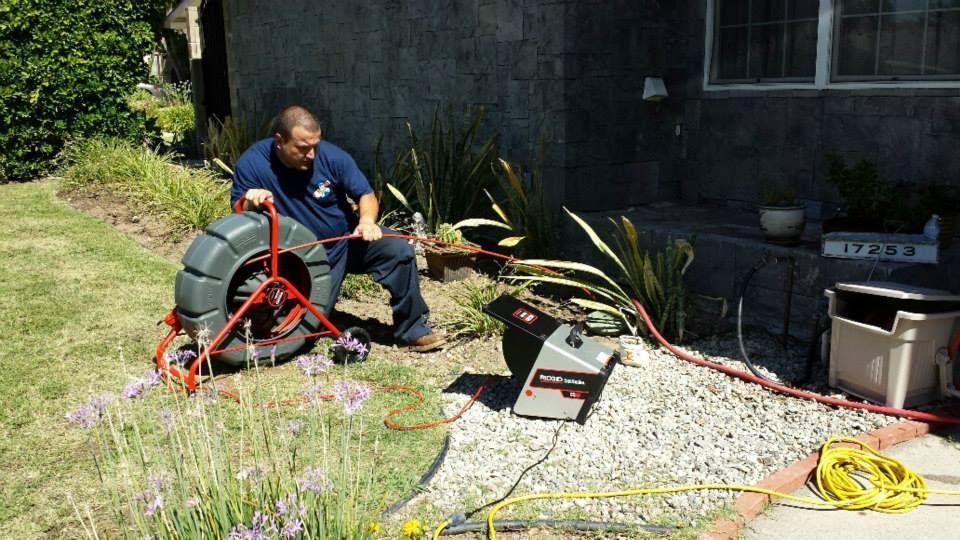
Depth changes the price, so we measure it first
Every quote we hand a Porter Ranch owner comes after a camera run with a surface locate, so the footage and the burial depth of the defect are known numbers rather than assumptions.
On steep lots that single step often turns a feared full-lateral replacement into a targeted repair at one joint, and it stops the other outcome too: a cheap-sounding estimate that grows once somebody discovers the pipe is nine feet down at the curb.
Grade also changes how a line behaves when it does get a partial blockage. A steep lateral pushes water past an obstruction long after a flat one would have surrendered, so a Porter Ranch house can run for months with a substantial defect and only a faint gurgle to show for it. When it finally backs up, it backs up at the lowest fixture in the house, which on these floor plans is often a downstairs powder room or a garage floor drain, and it does it without much warning.
Slow Drains or a Stoppage in 91326?
We scope the line, show you the footage, and price the repair in writing before anything starts.
Call 818-280-9135The Older Half of Porter Ranch
Not every house up here is from the master-planned era. The blocks toward the south end, closer to Rinaldi Street and the older Northridge and Chatsworth boundaries, were built well before the hillside tracts and they are plumbed like their neighbors: cast iron out of the slab, sometimes vitrified clay from the property line to the main, occasionally a stretch of clay under a front yard that has been growing an olive or a ficus over it for fifty years.
For those properties the whole calculus changes. We are looking for scale and channeling in the iron, root intrusion at clay joints, and the classic pattern of a stoppage that returns on roughly the same schedule every year. Hydrojetting with a root head resets the line properly, and a cured-in-place liner seals the joints permanently so there is nothing left for a root to enter. Two houses a mile apart in the same ZIP code can need completely opposite work, which is exactly why we do not quote sewer repair over the phone.
What Actually Stops Up a Modern Kitchen Line
Set the pipe material aside for a moment, because a fair share of what our rooter trucks clear in Porter Ranch has nothing to do with the ground. Large modern kitchens with high-powered disposals send far more food solids down the drain than the plumbing of any era was designed for, and fats poured while hot congeal into a waxy layer once they hit a cool underground pipe. Add wipes marketed as flushable, which do not break apart the way paper does, and you have a blockage that a plastic pipe with perfect grade will still hold onto.
This is a maintenance problem rather than a structural one, and it responds to maintenance. Jetting a kitchen line every year or two on a house that entertains heavily is cheaper than an emergency call on a holiday weekend, and it is the single most useful piece of advice we give homeowners in this neighborhood.
How a Porter Ranch Call Usually Goes
A technician arrives from our Northridge yard, typically inside thirty to sixty minutes for an emergency in 91326. If the house is not draining, clearing the stoppage comes first so the property is usable. Once flow is restored we put a camera in through a cleanout, run the line to the city connection, and record what is there. You watch the monitor while it happens. Then we talk about whether you are looking at a maintenance item, a single-joint repair, or a lateral that should be relined, and you get the number in writing before a shovel comes off the truck. Replacement work in the City of Los Angeles is permitted and inspected, and we handle that paperwork.
Sewer Work We Handle in Porter Ranch
We are a sewer and underground pipe company and nothing else. The following list is the whole catalogue, performed by our own crews:
Equally important is what we leave to others. We do not install or repair water heaters or tankless units, faucets, toilets, sinks, disposals, water softeners, copper supply repipes or gas lines, and we do not rough in plumbing for new construction. Underground drainage is the entire trade here.
Symptoms Worth Acting On Before They Escalate
Because grade masks trouble on these lots, the early signals are subtle. Any of the following on a Porter Ranch property is worth a scope rather than a wait-and-see:
- A single fixture at the low end of the house that is always the first to slow, while everything upstairs behaves normally
- A faint sucking or gulping from a downstairs trap when the dishwasher or laundry discharges its full load at once
- Repeat stoppages that arrive every four to six months on a house too new to have root damage, which almost always means a sag or an offset holding solids
- Damp soil, a soft spot, or settling pavers along the run between the house and the street where nothing is irrigated
- Sewer odor near a cleanout cap or in a side yard on still mornings
- A newly added deck, pool or extended driveway over the lateral alignment, followed within a year or two by drainage complaints
Catching a settled joint while it is still a joint is a spot repair. Catching it after it has separated and started washing soil into the pipe is an excavation, sometimes under something you paid a landscape contractor a great deal of money to build.
Questions Porter Ranch Homeowners Ask Us
My house is only about twenty-five years old. Can it really need sewer work already?
Yes, and age is the wrong thing to look at here. Porter Ranch laterals are plastic, so they do not corrode or scale the way older iron and clay lines do. What they do is move with the ground they sit in. Pads on this hillside were built with cut and fill, and fill consolidates for years, so a lateral crossing that boundary can develop an offset joint or a low spot long before the pipe itself is worn out. A camera answers the question in twenty minutes.
What is the difference between an offset and a belly, and does it matter?
It matters a great deal, because they are repaired differently. An offset is a step where one section of pipe has dropped or shifted relative to the next one, leaving a lip that catches solids. A belly is a length of pipe that has sagged into a dish so waste water stands in it. A single offset joint is often a short spot excavation. A belly cannot be repaired by lining, because a liner follows the existing shape, so restoring grade means either digging that section or pulling a new line through on the correct alignment.
Can you do trenchless work on a lot with retaining walls and heavy landscaping?
That is usually where trenchless earns its keep. Pipe bursting and cured-in-place lining both work from small access pits rather than a continuous trench, so a mature hillside yard, a paver driveway or a pool deck can stay intact. The limiting factors are collapsed pipe that leaves nothing to pull through, severe bellies that need re-grading, and access for the equipment. We tell you which case you are in after the camera run, not before.
Do I need a permit to replace a sewer lateral in Porter Ranch?
Replacing a sewer lateral in the City of Los Angeles is permitted work and gets inspected. We pull the permit as part of the job. Cleaning a line, jetting it or running a camera does not require one. The homeowner owns the lateral from the building to the connection at the city main, so the repair and the permit are the property owner's responsibility even when the failure sits under the parkway.
Is there any point in a sewer inspection before I buy a house up here?
There is, and buyers in newer neighborhoods skip it more often than they should precisely because the house looks new. A standard home inspection does not put a camera in the sewer. On a graded hillside lot, a scope tells you whether the lateral is straight, whether it has taken a settlement offset, how deep the street connection is, and whether previous owners added hardscape over the alignment. That is worth knowing before closing rather than after.
Other Valley Neighborhoods We Cover
We run the same equipment and the same crews across the rest of the San Fernando Valley. Pick your area below:
Get a Porter Ranch Sewer Line Scoped
BBC Rooter & Plumbing, CSLB #720343. Licensed, insured, and answering the phone every day of the week.
Call 818-280-9135