_1773179633783-DiqUK4T2.png)
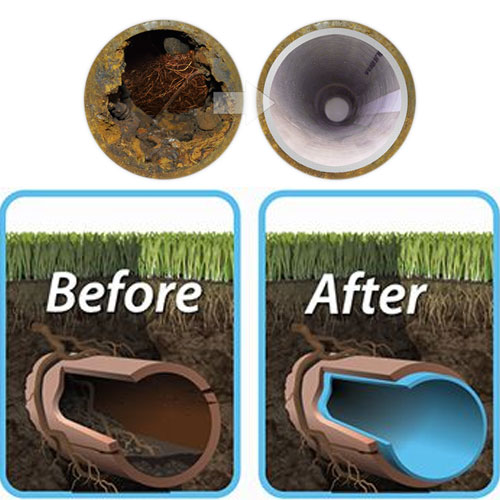
Sylmar sits higher, rockier and further out than the rest of the San Fernando Valley, and the sewer work up here reflects all three. BBC Rooter & Plumbing is a sewer and underground-pipe contractor working out of Northridge, roughly twenty minutes south of Foothill Boulevard, and Sylmar is one of the areas our trucks run to most often. Long driveways, deep front setbacks, cobble in the trench line and a fifty-plus-year-old earthquake that still turns up on camera footage — those conditions shape nearly every job we take at a 91342 address.
Everything on this page concerns one thing: the sewer lateral, meaning the buried pipe that carries waste from your building out to the city main under the street, plus the branch drains feeding it. We do not install or repair water heaters, faucets, toilets, sinks, garbage disposals, water supply repiping, water softeners or gas lines. Buried pipe is the entire business. If a Sylmar property has a backup happening right now, call 818-280-9135.
Working on Sewer Lines at the Foot of the San Gabriels
Sylmar is the northernmost neighborhood in the City of Los Angeles, wedged into the corner where the Valley floor stops being flat and starts climbing into the San Gabriel Mountains. Streets above Foothill Boulevard gain real elevation quickly; by the time you reach the upper ends of Roxford Street, Hubbard Street or the blocks near El Cariso Community Regional Park, you are several hundred feet above the flatlands around Van Nuys. The community was laid out in 1890 around what was then promoted as the largest olive grove in the world, annexed to Los Angeles in 1915, and kept a semi-rural character far longer than the tract neighborhoods to the south.
That grade is not a trivia point. Sewer laterals run on gravity, and a steeper lateral moves solids faster, which is generally good. But steep runs also mean that where the pipe flattens out or dips, everything the fast section carried drops out and stays there. On Sylmar hillside properties we routinely find a clean, scoured upper run and a heavily packed section right where the pipe levels off near the street. A camera inspection makes the difference obvious in about ten minutes. We cover the whole 91342 footprint: the Olive View area near the medical center, the blocks off Polk Street and Astoria Street, the Glenoaks Boulevard and Roxford corridor, Sayre Street, Bledsoe, Gladstone, and the equestrian parcels running up toward the Angeles National Forest boundary.
What the 1971 Quake Left Underground
On the morning of February 9, 1971, a magnitude 6.6 earthquake ruptured the ground along the San Fernando fault zone directly beneath this community. It is remembered locally as the Sylmar quake. Freeway interchanges came down, Olive View Medical Center was so badly damaged it had to be rebuilt, and the Lower Van Norman Dam came close enough to failing that tens of thousands of people downstream were evacuated. Above ground, the damage was catalogued and repaired within a few years.
The part nobody inspected
Buried vitrified clay pipe is strong under compression and brittle under shear. Ground that moves laterally does not break clay in a clean, obvious way — it pulls joints apart a fraction of an inch and cracks bells. A lateral in that condition still drains. It passed every visual check a 1971 homeowner could make, because there was nothing to see from inside the house.
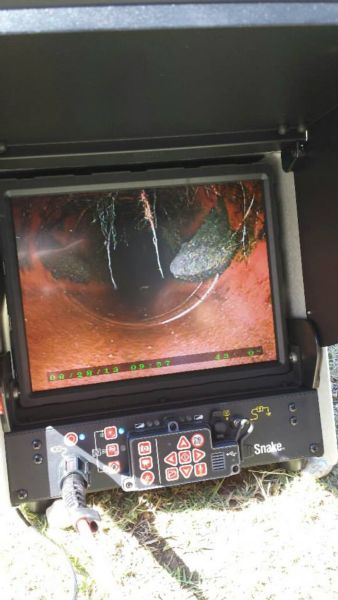
Fifty-five years later we put a camera down those same lines and find hairline separation at joint after joint, each one packed with root hair. In most cases the fix is a cured-in-place liner rather than a full dig.
The practical rule for Sylmar: if the house predates 1971 and is still on its original lateral, assume the quake touched that pipe and get it scoped before you finish a remodel, pour a new driveway or list the property. Post-quake reconstruction from the 1970s and early 1980s brought in ABS and PVC, which held up far better, though the earliest of those runs are now hitting their own fifty-year mark and the rubber couplings at their transitions are frequently the weak point.
Cobble, Wash Rock and Why Digging Costs More Here
Sylmar is built on an alluvial fan. For thousands of years, storm flows out of the Pacoima Wash, Little Tujunga Canyon and the smaller drainages behind the community carried rock down out of the mountains and spread it across this end of the Valley. What is under a Sylmar front yard is generally not the fine silty loam you hit in Reseda or Van Nuys. It is sandy, gravelly, and studded with rounded cobble and the occasional boulder, mixed with decomposed granite.
That changes the job in three specific ways, and an honest contractor tells you about all three before quoting:
Open excavation runs slower
Cobble and buried boulders stall a mini excavator and force hand work around the pipe. A trench that takes half a day in soft Valley fill can take a full day here, and spoil removal is heavier. This is the single biggest reason a dig-and-replace bid in Sylmar comes in above the same footage in the flats.
Pipe bursting is not always the right call
Bursting works by fracturing the old pipe and shoving the fragments outward into surrounding soil. In loose sandy ground it works beautifully. In tightly packed cobble there may be nowhere for the debris to go, and the head can deflect off a boulder. On rocky Sylmar runs we often recommend lining or a targeted open cut instead.
Point damage from rock loading
A cobble bearing directly on a clay or cast iron pipe wall concentrates load on one spot. Decades of small ground movements around that stone produce the cracked crown and longitudinal fracture we see fairly regularly on Sylmar camera runs, usually with no root involvement at all.
Big Lots, Long Laterals and Where the Cleanout Should Be
Residential parcels in Sylmar are among the largest inside Los Angeles city limits. Quarter-acre lots are common, half-acre and larger are not unusual, and the horse-keeping blocks are larger still. That generosity is wonderful for the people living there and expensive for the pipe underneath them, because the distance from a house to the main in the street can be two or three times what a Panorama City bungalow deals with.
More linear feet means more joints, more chances for a belly to form, more root entry points, and a bigger number on any full-replacement estimate, since lining and bursting are both priced largely by the foot. It also means the location of your cleanout matters enormously. A great many older Sylmar homes have a single two-inch or three-inch cleanout tight against the house and nothing at all out near the property line. When the blockage is one hundred and twenty feet away, a cable run from the house has to fight every bend along the way before it even reaches the problem.
On long Sylmar runs we routinely recommend adding a two-way cleanout near the property line during any repair. It is a modest add-on while the trench is already open, and it turns every future service call into a fast, straightforward job instead of an ordeal. It also gives us a proper access point for hydrojetting, which needs a good downstream entry to be effective.
Horse Property, Septic Holdovers and Private Sewage Lines
Parts of Sylmar were developed before city sewer mains reached them, particularly the outlying parcels north and east of Foothill Boulevard toward the forest boundary. Some of those properties were connected to the public system as mains were extended; others were left on septic tanks and seepage pits, and a number of them still are. Equestrian and large-acreage parcels are the most likely candidates.
Here is where our scope begins and ends on those properties. We handle the building sewer — the line running from the structure out to wherever it terminates, whether that is a city main or a private tank. We camera it, clear it, jet it, repair it and replace it. We do not pump septic tanks and we do not design or install leach fields; if the tank itself is the issue, we will tell you plainly and you will need a septic pumper for that part. What we see most often on these parcels is a long, shallow, hand-dug original line to a tank, followed decades later by a connection to the street, with the abandoned segment still tied in and collecting water.
Olive Roots, Pepper Trees and the Joints They Open
The olive groves that gave Sylmar its name and its early economy are mostly gone as commercial agriculture, but mature olive trees survive throughout the older residential blocks, along with California pepper trees, eucalyptus windrows planted as agricultural shelter belts, and native sycamores following the wash lines. Every one of those species is drought-adapted, which is exactly the problem: a drought-adapted tree has an aggressive, opportunistic root system that hunts moisture over long distances.
A sewer lateral is the most reliable water source on a dry Sylmar lot. Roots do not smash into pipe; they find the vapor escaping from a joint that the 1971 quake or ordinary settlement opened by a hair, push a fine hair through the gap, and then thicken. By the time a homeowner notices a slow drain, that hair has become a fibrous mass filling most of the pipe. Cabling shears the mass off and buys you months. Hydrojetting scours the pipe wall back to bare material and buys you considerably longer. Only lining or replacing the pipe closes the entry point permanently, and on Sylmar's older clay runs that is usually the conversation worth having.
Sewer Work We Perform at Sylmar Addresses
Every item below is done by our own crews, with our own equipment, on our own trucks. No brokered leads, no subcontracted digging.
Alongside those: root intrusion removal, excavation and repair of collapsed, bellied or offset sections, replacement of clay and cast iron laterals, sewer gas source tracing, pre-purchase sewer scopes for buyers and agents, and commercial sewer rehabilitation for the industrial and light-manufacturing properties along the Glenoaks and San Fernando Road corridor.
Get a Sylmar Sewer Truck Out Today
Camera inspection included with any repair we perform. Written number before a shovel moves.
Call 818-280-9135Early Signs a Sylmar Lateral Is Going
Sewer laterals almost never fail without warning. They warn quietly, for months, in ways that are easy to explain away. On Sylmar properties these are the signals worth acting on:
- A drain that clears itself and then repeats on a schedule — a root mass regrowing to the same choke point every few months is the classic old-clay pattern here
- Toilets that bubble when the washer discharges — air being pulled past a partial obstruction downstream
- A wet strip or an unusually green line across a dry Sylmar yard, often visible from an upstairs window before it is visible from the ground
- Sewer odor outdoors near the driveway or side yard, strongest in the early morning when the air is still
- Settlement or a dip in a driveway or walkway that follows the run of the pipe, which on rocky ground can mean soil is washing into a break
- Two or more fixtures at opposite ends of the house going slow in the same month — the shared main is the common factor, not the fixtures
Any one of those justifies a camera inspection. We push a self-leveling camera the full length of the lateral, mark the depth and surface position of anything significant, and hand you the footage. What you do next is your decision, made with the same information we have.
Sylmar Service Map
Trucks leave our Northridge yard on Yolanda Avenue and reach most Sylmar addresses in thirty to sixty minutes depending on the 118 and 210 traffic.
Questions We Get From Sylmar Property Owners
Is sewer excavation harder in Sylmar than elsewhere in the Valley?
Usually, yes. Sylmar sits on an alluvial fan built by storm flows out of the San Gabriel Mountains, so the ground under most yards here is sandy and gravelly with rounded cobble and occasional boulders mixed through it, plus decomposed granite. Cobble slows a mini excavator, forces hand digging around the pipe, and makes spoil heavier to haul. It also affects method choice: pipe bursting needs somewhere for the fractured old pipe to displace into, and tightly packed rock does not always give it that. We tell you which method your soil will accept before we quote, not after.
My Sylmar property is on a septic tank. Can you still help?
Partly, and we will be clear about the line. We work on the building sewer, meaning the pipe running from the structure out to wherever it ends, whether that is a city main or a private tank. We camera it, cable it, jet it, repair it and replace it. We do not pump septic tanks and we do not design or install leach fields. If the tank itself is the problem, we will show you what we found and tell you to call a septic pumper for that portion. A common find on these parcels is an old hand-dug line to a tank that was never properly abandoned when the property was later connected to the street.
Can a 1971 earthquake really still be causing sewer problems in 2026?
It can, and in Sylmar it frequently is. The magnitude 6.6 quake on February 9, 1971 ruptured ground along the San Fernando fault zone directly under this community. Vitrified clay pipe does not fail obviously under that kind of lateral movement. Joints pull apart a fraction of an inch and pipe bells crack, and the line keeps draining, so nobody inspects it. Fifty-five years of root growth and soil intrusion through those openings is what we see on camera today. If the house predates 1971 and is on its original lateral, assume the pipe was affected and have it scoped.
My lot is over half an acre. Does that make the sewer line more expensive to fix?
It usually does, because both lining and pipe bursting are priced largely by the linear foot and a large Sylmar parcel can put the city main two or three times farther from the house than a small tract lot would. More footage also means more joints, more potential low spots and more root entry points. The offsetting good news is that long runs are excellent candidates for trenchless work, since the alternative is trenching most of a driveway or yard. On any long run we also recommend adding a two-way cleanout near the property line while the trench is open.
How quickly can you reach a Sylmar address?
Our trucks dispatch from Yolanda Avenue in Northridge, and typical arrival at a 91342 address is thirty to sixty minutes depending on traffic on the 118 and 210. The office is open seven days a week from 6am to 6pm and the emergency phone is answered around the clock. For an active backup, call 818-280-9135 and say it is a main line backup so we route the right truck.
Valley Cities Next Door
Sylmar is the top of our route. Working south and west, these are the other communities our crews cover on the same day:
A Sewer Contractor for Sylmar, Not a Fixture Plumber
BBC Rooter & Plumbing, owned by Babak Behzadi. CSLB #720343. Buried pipe is all we do.
Call 818-280-9135