_1773179633783-DiqUK4T2.png)
BBC Rooter & Plumbing runs the far west end of the San Fernando Valley every week, and West Hills is one of the ZIP codes our trucks see most. We are not a general plumbing shop that also snakes drains on the side. Sewer laterals, main lines and buried pipe are the entire business, and West Hills — with its deep setbacks, long driveways and rising ground toward the Simi Hills — is exactly the kind of place where that narrow focus earns its keep.
If a main line is backing up into a tub or a floor drain while you are reading this, stop and call 818-280-9135. Otherwise, treat this page as a working guide to what is buried under West Hills property: when it went in the ground, what it was made of, how it tends to fail, and what an honest repair actually involves.
Why West Hills Sewer Lines Behave Differently From the Rest of the Valley
Most of the San Fernando Valley filled in during a fifteen-year building rush after 1946. West Hills did not. This corner stayed ranch land and orchard well after Van Nuys and Panorama City were fully platted, and the tracts that define the area today mostly went up between the early 1960s and the late 1970s, with custom and semi-custom building continuing along the western edge into the 1980s and 1990s. The community did not even carry its current name until 1987, when residents on the west side of Canoga Park voted to separate the identity of the hillside neighborhoods from the flatland commercial strip to the east.
That later build-out matters underground. A 1949 house in Van Nuys almost certainly left the factory with vitrified clay in the trench. A 1968 house on the Roscoe Boulevard side of West Hills probably got cast iron under the slab and clay or early plastic outside it. A 1987 house on the ridge got ABS. Three different eras, three different failure clocks, all inside the same two ZIP codes. When a homeowner tells us "the house is newer, the sewer should be fine," that is the single most common wrong assumption we correct in this neighborhood.
Flatland Tracts and Hillside Edges: Two Very Different Sewer Problems
Draw a rough line down Valley Circle Boulevard and West Hills splits into two plumbing worlds.
East of that line, along the Sherman Way, Vanowen and Roscoe corridors and out toward Fallbrook Avenue, the layout is conventional Valley tract: rectangular lots, homes set thirty to fifty feet back, laterals of moderate length running at a normal fall to a main under the street. Shadow Ranch Park sits in the middle of this area, and the neighborhoods around it were built when clay and early cast iron were still standard. Failures here are the classic ones — joints that have separated a quarter inch, root hair pushing through the gap, a belly where the trench backfill settled unevenly.
West of Valley Circle, climbing toward Bell Canyon and the Simi Hills, everything stretches. Lots get larger, houses sit farther from the curb, and laterals of 120, 180, even 250 feet are ordinary rather than remarkable. Some of these runs drop twenty feet or more in elevation between the house and the street. Homeowners assume steep is good for drainage. It is not always. When a pipe falls too fast, water outruns the solids it is supposed to carry, and the solids stack up at the first place the grade flattens. We open lines in the hillside pockets of West Hills that are choked halfway down a long run with no root, no crack and no obvious cause other than geometry.
Fill soil keeps moving after the house is finished
The hillside subdivisions on the west side of the community were graded with engineered fill, and fill continues to consolidate for decades after the grading permit is signed off. A lateral bedded in that fill goes in at a correct slope and slowly loses it. On a camera inspection this shows as a pool of standing water in an otherwise clean pipe.
A belly is not an emergency, but it is a debris trap, and it is the reason some West Hills homes need the main line cleared every year or two forever until the sag is corrected.
The 1984 to 1990 ABS Window
Anyone who works sewer lines in the west Valley knows this date range by heart. For roughly six years, several manufacturers produced ABS drain, waste and vent pipe using resin formulations that did not hold up. The pipe installs fine, passes inspection, and then somewhere past year twenty-five it starts to fracture — often as a split running lengthwise down the barrel of the pipe rather than a failure at a fitting. West Hills has a meaningful number of houses from exactly that window, particularly on the newer western tracts.
The practical consequence for an owner is that the usual reasoning does not apply. There is no root ball, no rusted iron, no crushed clay bell. The camera shows a pipe that looks almost new except for a dark seam where the wall has parted. Because the defect is in the material rather than at the joints, spot repairs tend to be a losing strategy; if one length has gone brittle the neighbors usually have too. Full replacement of the affected run — most often by pipe bursting, which pulls modern HDPE through the old path — is the durable answer.
Sewer Backing Up in West Hills? We Dispatch From Northridge.
Camera inspection included with any repair. Written estimate before a shovel moves.
Call 818-280-9135What Sixty Years of Roots Do to a Clay Joint
Older West Hills streets were landscaped in the era when Los Angeles planted whatever grew fast. The parkways carry mature liquidambar, ficus, Chinese elm and jacaranda, and the private lots — especially the bigger ones out west — hold pepper trees, eucalyptus and old citrus left over from the ranch and orchard days. Orcutt Ranch on Justice Street is the surviving reminder of what this land grew before it grew houses.
Roots do not drill through sound pipe. They find vapor. A clay lateral leaks a trace of warm, damp air at every bell-and-spigot joint, and a root that encounters that vapor turns toward it and thickens inside the gap until it becomes a mat. Once the mat is established, everything that comes down the line — paper, grease, wipes — catches on it. Owners often describe a slow decline over two or three years, then a sudden total blockage after a holiday weekend.
Cabling with a rooter blade cuts a channel through the mat and restores flow the same day, which is the right emergency move. It is not a repair. The root is still there and it grows back on a schedule set by the tree, not by you. The honest sequence is: clear the line, put a camera down the clean pipe, see how large the entry point is, and then decide between hydrojetting on a maintenance interval and sealing the pipe permanently with a liner.
Rebuilding a 180-Foot Lateral Without Trenching the Front Yard
Trenchless work is the reason a long West Hills lateral is not the financial disaster it sounds like. There are two methods and they solve different problems.
Cured-in-place lining pulls a resin-saturated felt tube through the existing pipe, inflates it against the wall and cures it into a continuous jointless pipe inside the old one. It seals every root entry at once and it needs only one access point on most runs. It requires the host pipe to still be round and roughly intact — a cracked clay line is a good candidate, a collapsed one is not.
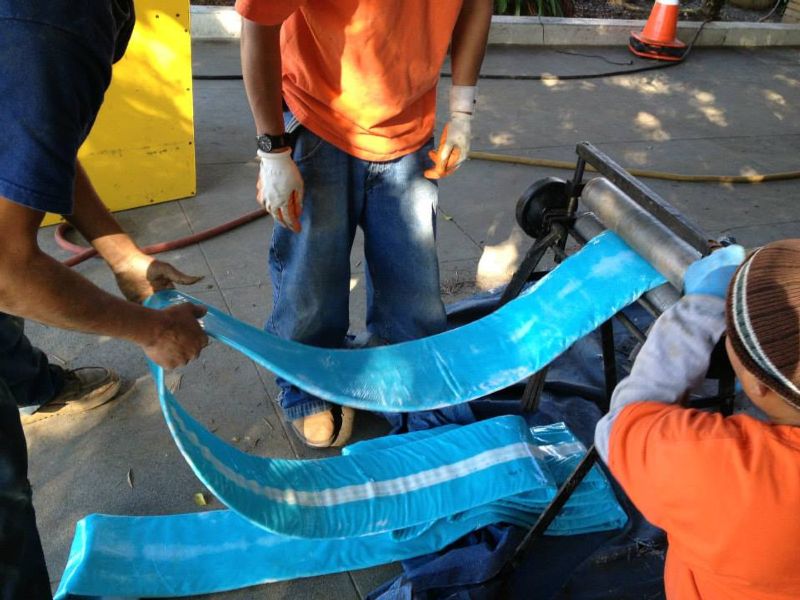
Pipe bursting sends a conical head through the old line on a cable, splitting the original pipe outward into the surrounding soil while towing new HDPE in behind it. It works on collapsed pipe, on brittle ABS, on badly offset joints, and it can upsize a four-inch line to six inches on the way through. It needs a pit at each end, which on a West Hills lot usually means one small excavation in a planting bed near the house and one near the parkway.
Either way, the mature landscaping, the stamped concrete driveway and the pool deck that sit over the middle of the run stay untouched. On lots where the lateral crosses a slope, we also look at whether an added cleanout at the top of the run will make every future service call cheaper. It usually will.
Sewer and Underground Pipe Work We Handle in West Hills
Everything below is performed by our own crews. We do not broker the job out to a subcontractor and mark it up.
What we do not take on
We are a sewer and underground pipe contractor, and we stay in that lane. We do not install or repair water heaters or tankless units, we do not do faucets, toilets, sinks or garbage disposals, we do not repipe water supply lines or chase pinhole copper leaks, and we do not handle gas piping, water treatment equipment or new construction plumbing. If your West Hills problem is on the supply side of the house we will tell you plainly and point you elsewhere rather than sell you something we are not the best at.
Early Warnings That Show Up First on a Long Lateral
Sewer lines fail slowly and then all at once. On the extended runs common in West Hills the early signals are easy to miss because the trouble is a hundred feet from the house. These are the ones worth a phone call:
- The lowest fixture in the house acts up first. A downstairs shower or a garage floor drain that gurgles or backs up while everything upstairs seems fine is a classic main line warning.
- The toilet level drops or rises on its own when the washing machine discharges — air is being displaced through a partial obstruction.
- A strip of lawn stays green through August without irrigation, or the soil over the lateral feels spongy underfoot.
- Sewer odor outdoors on still evenings near the front planting beds, with nothing wrong indoors.
- The main line needs clearing on a predictable cycle. Once a year is a root schedule. Every few months is usually a belly or a break.
- Small dark flies collecting near a bathroom or laundry drain, which often means a cracked pipe under or beside the foundation.
Any one of these justifies putting a camera down the line before it becomes a Saturday night emergency and a carpet replacement.
Coverage and Drive Times Into 91304 and 91307
Our crews stage out of Northridge and reach most West Hills addresses in 30 to 60 minutes depending on traffic on Roscoe and Vanowen. We work the whole community — the tracts around Shadow Ranch Park, the streets off Valley Circle, the Platt Avenue and Justice Street neighborhoods, the commercial buildings near Fallbrook Avenue, and the medical and office properties along Sherman Way.
West Hills Sewer Questions We Get Asked
Do you actually work in West Hills, or only the east Valley?
West Hills is one of our regular routes. Our shop sits on Yolanda Avenue in Northridge, roughly six miles east of Valley Circle Boulevard, and a truck usually reaches a 91304 or 91307 address in 30 to 60 minutes. We take calls seven days a week from 6am to 6pm and answer the emergency line around the clock. The number is 818-280-9135.
My house was built in 1986. Isn't the sewer line too new to fail?
Not necessarily. A large share of West Hills construction from roughly 1984 through 1990 used ABS drain pipe made with resin blends that turned brittle over time. Those laterals can split along the length of the pipe rather than at a joint, which is the opposite of how old clay fails. A house that looks modern can still have a lateral that is cracking. A camera run settles the question in under an hour.
My lateral runs almost 200 feet to the street. Does that rule out repair?
No. Long runs are actually where trenchless methods save the most money. We set a small launch pit near the house and a receiving pit near the city connection, then either pull a new pipe through the old path by bursting or cure a resin liner in place inside the existing pipe. The driveway, the lawn and the hardscape in between stay where they are. Length mainly affects material cost, not feasibility.
Who is responsible for the sewer line at a West Hills house, me or the city?
West Hills is part of the City of Los Angeles, so the sanitation department maintains the main line running down the street. The house connection sewer, meaning the pipe from your building out to the point where it ties into that main, is the property owner's responsibility. That is the section we camera, clean, line, burst or replace. If the blockage turns out to be in the city main we will tell you so and you can call the city instead of paying us.
Can hydrojetting damage an older pipe?
It can if it is done blind on a pipe that is already broken. That is why we camera first. If the line is structurally sound and simply coated with grease, scale or fine roots, jetting restores full diameter and is the right call. If the camera shows an open crack, a collapsed section or badly offset joints, jetting is the wrong tool and we say so and price the repair instead.
What will a camera inspection actually tell me?
Pipe material, pipe diameter, the depth and location of the line, the exact distance to any defect, whether roots are entering and where, whether the grade holds or the pipe has a belly holding standing water, and the condition of every joint along the run. You watch the monitor with the technician while it happens and we hand over the footage. Buyers use the same inspection before closing on a West Hills property.
More of the Valley Our Trucks Cover
If you own property elsewhere in the San Fernando Valley or the surrounding Los Angeles area, we work there too:
Get a Camera Into Your West Hills Sewer Line
BBC Rooter & Plumbing — CSLB #720343. Family owned, seven days a week.
Call 818-280-9135