_1773179633783-DiqUK4T2.png)
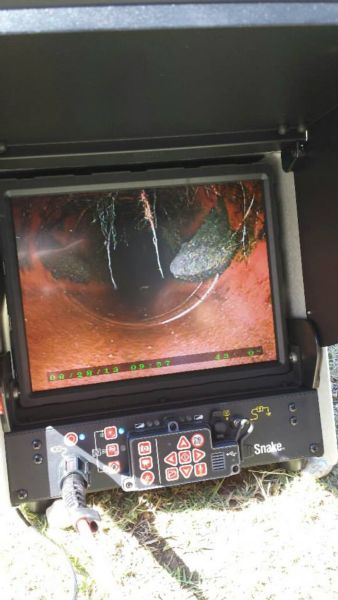
Winnetka is flat, it is dense, and almost all of it went up inside a fifteen-year window after the Second World War. That combination gives the neighborhood a very specific sewer profile: original vitrified clay laterals, laid in short mortar-jointed sections, now six and seven decades into a service life nobody designed them for. BBC Rooter & Plumbing works on those lines constantly — De Soto to Mason, Roscoe Boulevard down to Victory, and the apartment and restaurant blocks along Sherman Way.
We are a sewer and underground-pipe company, and only that. We do not sell water heaters, faucets, fixtures or copper repipes. What we do is find out what is actually happening in the buried line between your house and the city main, then clean it, line it, or replace it. Our trucks stage in Northridge, about ten minutes north of Winnetka Avenue and Saticoy Street. If a main line is backing up right now, call 818-280-9135.
Why Winnetka Sewer Laterals Fail on a Predictable Schedule
Nearly every original single-family lateral under Winnetka is vitrified clay pipe — VCP — typically 4-inch, occasionally 6-inch on the larger corner lots. Clay is chemically bulletproof. It does not corrode, it does not scale, and a clean section pulled out of a 1955 trench often looks new. The failure is never the pipe body. The failure is the joints.
Clay comes in short lengths, roughly two to four feet, so a 70-foot Winnetka lateral has somewhere between twenty and thirty joints in it. Those joints were sealed with mortar or hot-poured bitumen, both of which shrink, crack and wash out. Every joint is a potential doorway, and Winnetka sits on deep alluvial fill — sandy loam washed down out of the Santa Susana and Simi hills — that moves seasonally as it wets and dries. Over sixty years the pipe walks: sections drop, sections offset, and the mortar ring lets go.
Two other materials show up in local trenches. The first two to five feet coming out of the foundation is often cast iron, which does corrode, and which we routinely find with the bottom third channeled away. And a handful of Winnetka tracts — the late-1940s and early-1950s builders in particular — used Orangeburg, the tar-impregnated wood-fiber pipe sold as a cheap substitute for clay. Orangeburg does not crack; it deforms. When we camera a Winnetka line and the pipe has gone oval or collapsed into a flattened slot, that is almost always Orangeburg, and it is never worth cleaning. It gets replaced.
From the Charles Weeks Poultry Colony to Postwar Tract Housing
Winnetka started in 1922 as an agricultural experiment. Charles Weeks, a poultry farmer with a following and a slogan — "one acre and independence" — laid out a colony of one-acre chicken-and-fruit lots and named it after Winnetka, Illinois, betting that the Midwestern name would pull Midwestern buyers. It did, for a while. The colony was folded into the City of Los Angeles during the Valley annexations of the 1920s and the farming faded through the Depression.
What matters for your plumbing is what happened next. Those one-acre parcels were exactly the right size and shape for subdivision, and between roughly 1948 and 1965 practically all of them were cut into 6,000 to 7,500 square foot lots holding single-story ranch houses of 1,100 to 1,600 square feet. Winnetka has very little pre-war housing and very little new construction. It is a neighborhood built almost entirely in one material era — which is why sewer problems here tend to arrive in whole blocks rather than one house at a time.
Slab homes make it harder to see coming
A large share of Winnetka's 1950s and 1960s tracts are slab-on-grade, meaning the drain piping is cast into or buried under the concrete floor. There is no crawlspace to inspect and no visible pipe to check. The only way to know the condition of a slab-home lateral is to run a camera down it from the cleanout.
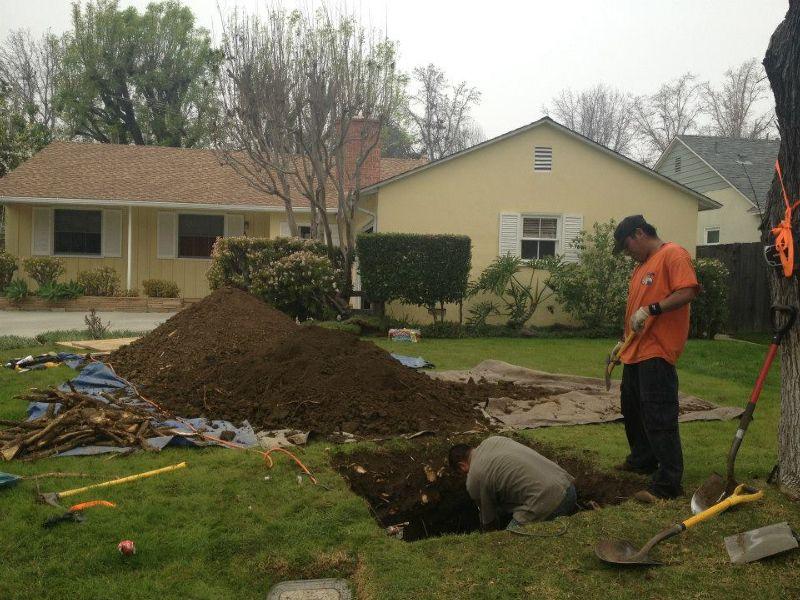
The upside: because Winnetka lots are shallow and the street mains are close, trenchless lining and pipe bursting work well here. Most laterals in 91306 can be rehabilitated through two small access pits without cutting the driveway or the slab.
Modesto Ash, Ficus and the Winnetka Parkway Root Problem
The strip of grass between the sidewalk and the curb — the parkway — is where the sewer story in Winnetka usually ends badly. Postwar Valley tracts were planted heavily and cheaply, and the species that went in are among the most aggressive rooters available: Modesto ash, Chinese elm, Indian laurel fig, California pepper, and carob. Modesto ash in particular was planted by the thousand across the west Valley in the 1950s and is now large, brittle, and sitting directly on top of the lateral it shares a trench line with.
Roots do not break clay pipe open. They find an existing gap — a failed mortar joint, a hairline crack, an offset shoulder — and grow toward the moisture and nutrients on the other side. A hair-thin root enters, thickens over two or three seasons, and turns into a fibrous mass that catches paper and grease. That is why so many Winnetka homeowners describe the same pattern: cleared with a cable, fine for eight months, backed up again.
Root balls at mortared clay joints
The signature Winnetka failure. Cable service shears the roots at the pipe wall and restores flow, but leaves the root structure outside the pipe intact. Hydrojetting cuts them back to the pipe wall and flushes the debris out; lining the joint is what actually stops them returning.
Bellies from settled trench backfill
Alluvial sand compacts unevenly. Where 1950s trench backfill settled, the pipe sagged into a low spot that now holds standing water and solids. A belly does not clear with a cable — it has to be jetted regularly or corrected by re-laying that section.
Grease loading behind Sherman Way kitchens
The restaurant and market frontage along Sherman Way, Roscoe and Winnetka Avenue puts real fats-oils-grease loading into older commercial laterals. These lines need scheduled jetting and interceptor service, not emergency rooter calls.
Channeled cast iron at the foundation
The short cast-iron stub between the slab and the clay is often the worst piece of pipe on the property — corroded from the invert up, with the bottom of the pipe gone. It is a cheap section to replace and a common cause of odor complaints.
What Winnetka Homeowners Usually Notice First
In a single-story slab house, a main line blockage announces itself at the lowest opening in the system, which is almost never the toilet. It is the hall bathroom tub or shower. Water backs up there first because that is where the drain sits closest to floor level. If you flush a toilet and the shower two rooms away burbles or fills, the problem is not the toilet — it is the main.
- Shower or tub filling when a toilet is flushed — the classic Winnetka slab-home main line symptom
- Laundry discharge backing up into a tub or floor drain — a washing machine dumps a large volume fast, so a partially blocked main fails there before it fails anywhere else
- Backups that return on a seasonal rhythm — roots grow hardest in spring; a line cleared in October that fails in March is a root line
- A soggy or unusually green stripe across the parkway or front lawn — leaking sewage is fertilizer, and it shows in the grass before it shows in the house
- Sewer odor near the foundation or in the garage — often the corroded cast-iron stub rather than the buried clay
- Sunken pavers, a dip in the driveway, or a soft spot over the trench line — soil is escaping into a broken pipe below
Any one of these is a reason to run a camera inspection before it becomes a 9pm emergency. We put the camera down the line, you watch the monitor with us, and you get told what the pipe is made of, where the defect is, how deep it sits, and what it will take to fix — in writing, before anyone starts work.
Main Line Backing Up in Winnetka? Call Now.
Same-day rooter and jetting across 91306. Camera inspection included with any repair, written estimate first.
Call 818-280-9135Sewer Work We Handle in Winnetka, Start to Finish
Everything below is done by our own crews with our own equipment — no subcontracted digging, no handed-off jetting.
Excavation and underground pipe repair, root intrusion removal, offset and bellied section correction, sewer gas diagnosis, and full lateral replacement in cast iron, clay or Orangeburg are all in scope. Water heaters, fixtures, water supply repiping and gas lines are not — if that is what you need, we will tell you plainly and point you elsewhere.
Flag Lots, Rear Units and the Winnetka Shared-Lateral Problem
Here is a Winnetka wrinkle that catches owners off guard, and it comes straight out of the neighborhood's history. When the one-acre Weeks Colony parcels were carved up after the war, the subdividers were working with deep rectangular lots that had a single narrow frontage on the street. The clean solution was a row of standard lots. The cheap solution, used often enough that we run into it most months, was to put one house at the front and a second dwelling behind it on a flag lot — a parcel whose only street contact is a driveway-width strip down the side.
A house needs a sewer connection, and a flag lot has almost no street frontage to put one in. So the rear property's lateral was frequently run forward along the flag pole, or worse, tied into the front property's existing lateral somewhere in the side yard. Decades later the two parcels have different owners who have never met, and neither has any idea their waste travels through the same pipe.
You find out during a backup. The front house has no symptoms at all and the rear unit is flooding, or both go at once, or a cable operator clears the blockage from the front cleanout and the rear owner gets a bill for a pipe on somebody else's deed. Nobody involved has done anything wrong; the paperwork simply never caught up with the plumbing.
The way through it is documentation before excavation. We camera the line, then push a sonde — a small radio transmitter riding the camera head — and walk the surface with a locator, marking the pipe's actual path and depth in paint on the ground. Frequently that reveals the run crossing a property line that no one expected. With the route physically marked, three questions get answers: where the tie-in sits, which parcel the defect is actually on, and whether a recorded easement exists. That is the difference between a repair two neighbors can agree to split and a dispute. It also matters for the repair method, because a shared line usually cannot be dug up without touching someone else's yard, which pushes the job toward trenchless rehabilitation from pits at either end.
Winnetka's Apartment Belt: Why Multi-Family Lines Fail on a Different Clock
The single-family tracts are only part of 91306. Along Sherman Way, Vanowen, Roscoe and the blocks flanking Winnetka Avenue sits a dense band of 1960s and 1970s income property — the tuck-under-parking dingbats, garden fourplexes and two-story courtyard buildings that went up when the Valley's rental demand outran its lots. Those buildings drain nothing like the ranch houses around them, and owners who treat them the same way get expensive surprises.
Three things are different. First, the building drain is shared: eight to sixteen units, all their kitchens and laundry, feed one 4-inch line to one lateral. A defect that a single-family house would tolerate for years — a modest belly, a partially root-choked joint — goes critical fast when sixteen households are pushing through it. Second, the loading is harsher. Cooking-grease volume in a fully occupied building is a genuinely commercial-scale problem arriving through residential-size pipe, and it congeals in exactly the low spots the trench settlement created. Third, and most costly, nobody upstairs knows or cares what goes down the drain. Wipes marketed as flushable, cat litter, cooking fat poured hot, and construction debris from unit turnovers all land in the same building drain, and they hang up on whatever roughness the pipe already has.
The failure signature is distinctive. Ground-floor units back up first, usually into the lowest opening — a tub or a floor drain near the laundry — while upper units run fine and report nothing. If the building has a laundry room, the giveaway is that the backup arrives during or just after a wash cycle, when thirty or forty gallons dump at once and briefly overwhelm a line that limps along at normal flow.
The economics favor a schedule over emergencies. Cable drain cleaning on a grease-loaded building drain punches a hole through the blockage and leaves the coating on the walls, so the interval to the next call keeps shortening. Hydrojetting scours the pipe back to its full diameter and carries the material out. On a fully occupied Winnetka building we generally recommend camera-scoping the building drain once to establish a baseline, then jetting on a fixed interval set by what the footage shows — commonly annual for a clean line, twice a year where there is a belly or heavy kitchen loading. Scheduled work also gets done at 9am on a weekday instead of at 11pm on a Sunday with tenants displaced and a habitability problem forming. For the buildings on this side of the Valley we cover the same approach in detail in our notes on jetting apartment buildings and on multi-family sewer rehabilitation.
One scope note for property owners, because it comes up on every call: we work on building drains, laterals and sewer mains. We do not service unit-level fixtures, water heaters, or supply piping. If the problem is confined to one apartment's sink and every other unit drains normally, that is a fixture call and a different trade. If it is the building drain, that is ours.
Where We Work Inside 91306
Winnetka's boundaries are compact, which is why response here is quick. We run the whole ZIP: the Winnetka Avenue and De Soto corridors, Mason and Corbin, the residential grid between Saticoy Street and Vanowen, the Sherman Way commercial frontage, the older apartment blocks near Roscoe Boulevard, and the tract streets running down toward Victory.
Winnetka Sewer Questions, Answered
My house was built in the 1950s. Is the sewer line still the original clay?
Unless a previous owner replaced it, yes — and most have not. Clay laterals from that era are still in the ground under the majority of Winnetka properties. That is not automatically a crisis; a clay line with tight joints can run for decades more. What determines the answer is the condition of the joints, and the only way to see them is a camera inspection. We will tell you honestly if the line has years left in it.
Who is responsible for the sewer pipe between my house and the street?
In the City of Los Angeles the property owner is responsible for the house connection sewer — the lateral — all the way to where it ties into the public main, including the portion running under the parkway and often under the street itself. The City maintains the main in the street. So if your blockage is in the lateral, which in Winnetka it usually is, it is your line to fix. We locate exactly where the defect sits so nobody pays to dig in the wrong place.
Roots come back within a year of every rooter service. Why?
Because cable rooter service cuts the roots flush at the pipe wall and leaves the root system outside the pipe alive and pressed against the opening. It regrows through the same gap. Two things actually break the cycle: hydrojetting, which scours the intrusion back and flushes the debris out instead of pushing it downstream, and sealing the entry point — either by lining that section or replacing it. If you are on an annual rooter subscription, you are renting a symptom.
Can a Winnetka lateral be replaced without tearing up the driveway?
Almost always. Winnetka lots are shallow and the mains are close to the curb, which is ideal for trenchless work. Pipe bursting pulls a new seamless HDPE line through the path of the old clay from two small pits; CIPP lining cures a new pipe inside the existing one. Concrete, pavers, mature landscaping and the parkway tree usually stay untouched. The exceptions are fully collapsed lines or severe bellies that need the grade corrected — those require opening that section.
We are buying a house in 91306. Is a sewer inspection worth it?
On a Winnetka home of this age it is one of the highest-value inspections you can buy. A general home inspector does not scope the lateral. A sewer camera tells you whether you are inheriting a sound clay line or a five-figure replacement, and the footage is leverage in escrow. We provide the video and a written condition report you can hand to your agent.
What do sewer repairs generally run in Winnetka?
Pricing depends on length, depth, material and access, so we quote off the camera footage rather than over the phone. Broadly, for local residential properties: rooter and drain cleaning runs a few hundred dollars; a camera inspection is typically credited toward repair work; hydrojetting is priced per session; CIPP lining is priced per linear foot; and a full lateral replacement is a project-scale number that varies widely with how deep the line sits and whether hardscape is involved. You get a written estimate before any work starts.
My sewer line runs under my neighbor’s property. Who is responsible for fixing it?
This is more common in Winnetka than people expect, because of how the old one-acre colony parcels were subdivided into front-and-rear lots. The short answer is that responsibility follows the recorded easement and the deed language, not intuition — and in the City of Los Angeles the owner remains responsible for their house connection sewer all the way to the public main regardless of whose grass it crosses. Before anyone argues, we locate the line with a camera and sonde and paint its real path and depth on the ground. Knowing exactly which parcel the defect sits on, and where the two lines tie together, settles most of these conversations in an afternoon.
I own a fourplex in Winnetka. How often should the building drain be jetted?
Set the interval off the camera footage, not off a calendar someone handed you. We scope the building drain once to establish a baseline, then schedule from what we see: a clean, correctly-graded line in a fully occupied building typically wants annual hydrojetting, while a line with a belly or heavy kitchen grease loading is usually twice a year. Buildings with a shared laundry room push more volume through in short bursts and tend toward the shorter interval. Scheduled maintenance on a weekday morning costs a fraction of an after-hours backup with tenants displaced.
Nearby Valley Neighborhoods We Also Cover
Winnetka sits in the middle of our service area, bordered by Canoga Park, Reseda, Chatsworth and Woodland Hills. We work all of them:
Sewer-Only, Licensed, and Ten Minutes From Winnetka
BBC Rooter & Plumbing — owner Babak Behzadi, CSLB #720343. Open 7 days, 6am to 6pm.
Call 818-280-9135