_1773179633783-DiqUK4T2.png)
Lake Balboa has a sewer problem the rest of the San Fernando Valley mostly does not: water coming into the pipe from outside. This is the flattest, lowest-lying corner of the central Valley, pressed up against the Sepulveda Basin, and on a good many properties here the groundwater sits close enough to the sewer lateral that a cracked joint stops being just an exit for waste and starts being an entrance for clean water. That single fact changes how a line fails, what a camera shows, and which repair method will actually hold.
BBC Rooter & Plumbing is a sewer and buried-pipe contractor, license CSLB #720343, running out of Northridge. Sewer laterals, main drains and underground pipe are what we do and the only thing we do. Water heaters, faucets, toilets, sinks, disposals, supply repiping, softeners and gas lines are outside our trade and we will refer you elsewhere for those without hesitation. If a 91406 property is backing up right now, call 818-280-9135.
A 1950s Tract Neighborhood That Got Its Name in 2000
Most of what people call Lake Balboa today was subdivided and built out in the late 1940s and 1950s as part of Van Nuys, in the enormous postwar push that filled the central Valley with single-story ranch houses on modest, regular lots. The neighborhood identity is much newer than the houses. Lake Balboa itself, the twenty-seven-acre lake inside Anthony C. Beilenson Park, opened in 1992 and is kept full with reclaimed water from the Donald C. Tillman Water Reclamation Plant next door. The surrounding community was formally recognized under the Lake Balboa name by the Los Angeles City Council around the turn of the millennium, and the neighborhood signs went up shortly after.
The gap between a 1990s and 2000s identity and a 1950s housing stock catches people out. Buyers see a newer-sounding neighborhood name and assume newer infrastructure. Underneath, the laterals are seventy years old, which in sewer terms is late middle age at best. We work the residential grid between Balboa Boulevard, Hayvenhurst Avenue, Woodley Avenue and Haskell, across Victory Boulevard, Vanowen Street, Sherman Way and Burbank Boulevard, and the age profile is remarkably consistent from block to block.
The Water Table Under the Sepulveda Basin
The Sepulveda Basin exists to flood. It is a flood control basin behind Sepulveda Dam, built by the Army Corps of Engineers in 1941, and its whole purpose is to be a low place the Los Angeles River can spread into during a storm instead of spreading into the neighborhoods downstream. The land immediately around it is correspondingly low and flat, the soils are fine river-deposited silt and sand, and shallow groundwater is a normal condition rather than an anomaly.
Why that matters for a buried pipe
A sewer lateral is designed to be a one-way system. Waste goes out; nothing comes in. That assumption depends on the pipe being above the groundwater, or at least being watertight.
When the surrounding soil is saturated and the pipe has open joints, hydrostatic pressure pushes water in through every defect. The line then runs partly full of clean groundwater all the time, and it carries fine silt in with it.
Groundwater Infiltration, the Failure Mode That Defines This Area
Infiltration is the technical name for it, and it produces a set of symptoms that look nothing like an ordinary clog. Here is what we actually see on Lake Balboa camera runs.
A line running wet with nothing draining
Push a camera into the lateral with every fixture in the house shut off and there is still standing or moving water in the pipe. On a properly sealed line the pipe should be essentially dry between uses. Water with no source inside the house came from outside it.
Silt and sand deposits with no grease or roots
Water entering through a joint brings fine soil particles with it. Those settle in the low spots and build into a gritty deposit that a cable slides straight over. It is a slow, progressive loss of capacity that homeowners describe as the drains getting worse every year.
Voids and sag over time
Every grain of soil washed into the pipe leaves a space behind it outside the pipe. Enough of that and the bedding under the lateral gives way, the pipe sags, and you now have a belly holding water permanently. This is the mechanism behind a large share of the bellied lines we find here.
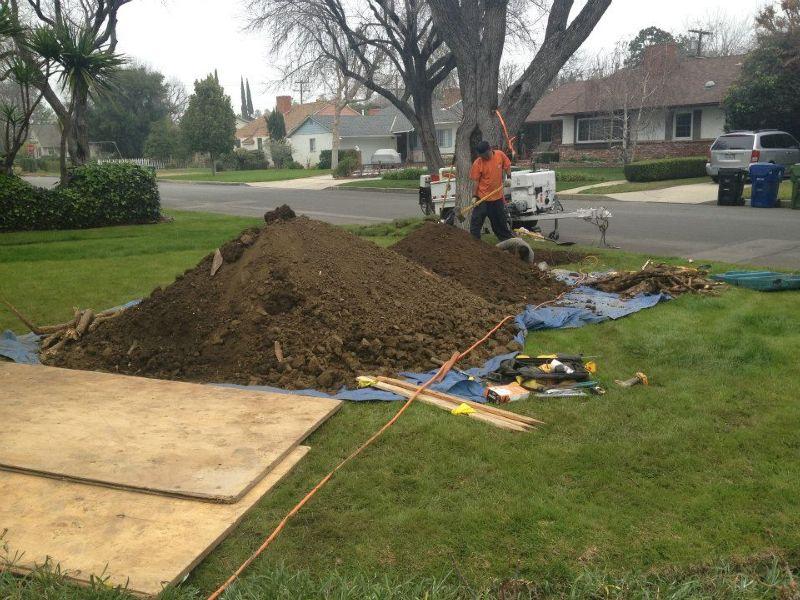
Infiltration also changes how we plan the repair. Excavating into saturated ground means shoring the trench properly and dewatering it, usually with a pump working continuously, because wet sand does not hold a vertical face. And before we cure a liner into a pipe that is actively taking on water, that flow has to be controlled, or the resin does not bond the way it should. None of that is exotic work, but it needs to be priced and planned honestly rather than discovered halfway through the day.
Flat Ground, Shallow Fall and the Bellied Lateral
Sewer laterals move by gravity, and gravity needs slope. The customary target for a residential building sewer is about a quarter inch of drop per foot of run. On the hillside neighborhoods of the Valley there is elevation to spare. Around Lake Balboa there is essentially none: the ground is close to level in every direction, so the entire fall available between a house and the street main is measured in inches, and the pipe was installed with almost no margin for error.
Take away a fraction of an inch of that slope through soil settlement and the run stops draining properly. A belly, meaning a sagging section that holds standing water permanently, is the single most common structural finding on our Lake Balboa scopes. Solids drop out in the standing water instead of being carried through, and the homeowner ends up on an endless cycle of cabling.
Bellies are worth understanding because they change the repair choice. Lining a bellied pipe puts a smooth new wall inside the sag but does not remove the sag, so the water still stands. Where a belly is the primary defect, the honest recommendation is excavation and re-bedding of that section at proper grade, sometimes combined with lining the rest of the run. We will show you the camera footage and the depth readings and explain why one section needs a dig even though the rest does not.
Willow, Cottonwood and What Grows Along the Basin Edge
Properties on the west and south sides of the neighborhood back toward the basin's open space, where the vegetation is water-loving in the extreme. Willow and cottonwood are phreatophytes, meaning their roots grow toward and into shallow groundwater as a matter of biology, and they are relentless about it. Add the mature ficus, Chinese elm and sweetgum planted through the 1950s tracts and the eucalyptus lines along some of the larger streets, and there is no shortage of root pressure on old clay.
The Lake Balboa twist is that roots and infiltration compound each other. Every joint that lets water in also lets a root in, and every root that thickens in a joint opens it further so more water enters. A line can carry both problems at once, which is why we look at whether the water in the pipe is clean or dirty and where it enters, rather than just cabling the roots and calling it done. Hydrojetting clears root mass and flushes accumulated silt in the same pass, which makes it a particularly good fit for this neighborhood.
Apartment Blocks on Victory and Sherman Way
Lake Balboa is not all single-family. The corridors along Victory Boulevard, Sherman Way, Vanowen and stretches of Balboa Boulevard carry a substantial stock of two-story apartment buildings and small multifamily properties, most of them from the 1960s and 1970s. Those buildings concentrate a lot of fixtures onto one building sewer, so a partial restriction that a single-family house might tolerate for months turns into a first-floor backup within days.
For owners and property managers, scheduled preventive jetting on a multifamily main is far cheaper than emergency response plus water damage in a ground-floor unit. We camera the main first to establish its condition and material, set a realistic interval, and work around tenants. The same applies to the retail and food service along those corridors, where grease is the driving problem rather than roots.
Sewer Services at Lake Balboa Addresses
Our own crews, our own equipment, no subcontracting:
Beyond that list: excavation and re-bedding of bellied and offset sections, replacement of failed clay and cast iron laterals, root intrusion removal, sewer gas source tracing, pre-purchase sewer scopes, apartment and commercial main line rehabilitation, and cleanout installation where none exists.
Backed Up Near the Basin Right Now?
Camera inspection included with any repair. Written price before work begins, every time.
Call 818-280-9135What a Lake Balboa Lateral Does Before It Quits
Given the ground conditions here, the warning signs skew toward water and silt rather than dramatic stoppages:
- Drains that have been getting gradually slower for years rather than failing suddenly, which points at silt accumulation in a low spot
- Backups that repeat every few months no matter how thoroughly the line was cabled, the signature of a belly holding water
- Standing water visible in the pipe on a camera run with every fixture in the house turned off
- Soft, spongy or sunken ground along the line of the lateral, where soil has been washing into a defect
- Drain performance that noticeably worsens in wet months and improves in late summer, tracking the groundwater level
- Sewer odor near a cleanout or in a side yard on still mornings
Each of those is answerable with a camera inspection. We record the run, mark depths and surface locations, and go through the footage with you on the spot so the recommendation is something you can see for yourself rather than take on faith.
Our Coverage Around Lake Balboa
Trucks come south from Northridge and typically reach 91406 addresses in thirty to sixty minutes. We cover the full residential grid around the park as well as the commercial corridors.
Lake Balboa Homeowner Questions
Why does my Lake Balboa yard stay damp even in the dry season?
There are two common explanations here and they call for very different responses. The first is simply shallow groundwater, which is normal for this low, flat ground next to the Sepulveda Basin and is not a plumbing fault at all. The second is a leaking sewer lateral saturating the soil around it, which usually shows as a damp strip following the run of the pipe rather than a general soggy area, often with grass that is greener and grows faster along that line. A camera inspection settles the question in one visit. If the pipe is intact we will tell you so and you have not spent money on a repair you did not need.
Does the shallow water table near the Sepulveda Basin affect sewer repair work?
It affects nearly every part of it. Excavating into saturated silt and sand means the trench has to be properly shored, because wet ground will not hold a vertical face, and it usually has to be dewatered with a pump running continuously while the work is done. It also affects trenchless work: if groundwater is actively flowing into the pipe, that flow has to be controlled before a liner is cured in place, otherwise the resin will not bond to the host pipe the way it should. None of this is unusual work for us, but it needs to be planned and priced up front rather than discovered at midday.
Can pipe lining still work if groundwater is getting into my sewer line?
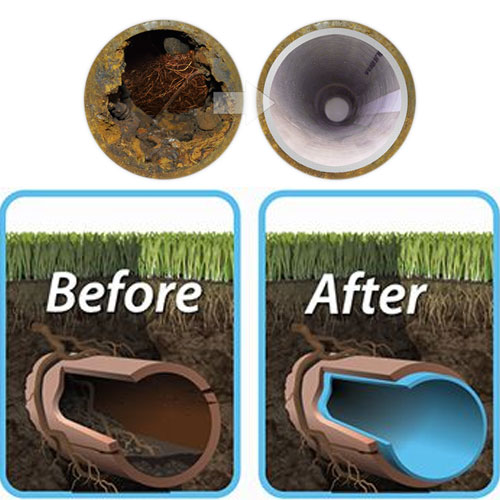
Usually yes, and lining is often the right answer, because a cured-in-place liner creates a continuous seamless wall through the old pipe and seals the joints that the water is entering through. The condition is that active flow into the pipe has to be stopped or reduced before the liner cures. Depending on what the camera shows, that can mean sealing a specific gushing joint first, bypassing flow, or dewatering the surrounding ground. The one case where lining is not the fix is a section that has sagged, since a liner follows the shape of the pipe it is installed into and will not lift a sag back to grade.
What is a bellied sewer line, and why do you find so many in this area?
A belly is a section of pipe that has sagged below its intended slope, so it holds standing water permanently instead of draining fully. Solids settle out in that standing water and build up until the line blocks, which is why a bellied lateral backs up again and again no matter how well it was cabled. They are common in Lake Balboa for two reasons. The ground here is close to flat, so the pipe was installed with only a few inches of fall to begin with and has no margin to lose. And where groundwater has been washing fine soil into a cracked joint, the bedding under the pipe erodes and the pipe settles into the void. The fix for a true belly is excavation and re-bedding at proper grade.
My drains back up after heavy rain. Is that my line or the city's?
It is worth investigating either way, and the timing is a real clue. Drain performance that gets worse in wet months and improves in late summer usually tracks the groundwater level, which points at infiltration into your own lateral through open joints or cracks. A sudden backup during a storm can also mean the pipe was already marginal and the extra volume tipped it over. We start with a camera run to establish the condition of your line, and if the evidence points to the public main rather than your side, we will tell you that plainly and you can take it up with the city instead of paying us to dig.
My house was built in 1953. What sewer pipe should I expect to find?
For a Lake Balboa house of that vintage, the most likely combination is cast iron running from the building out a short distance, transitioning to vitrified clay for the remainder of the run to the street main. Some runs from that period are clay end to end. A small number of late 1940s and early 1950s properties across the Valley also received Orangeburg, a bituminized fiber pipe that deforms into an oval as it ages. The camera identifies which of these you actually have within a few minutes, and that identification is what determines whether lining, bursting or a targeted excavation makes sense.
Other Valley Neighborhoods on Our Route
Lake Balboa sits near the middle of our service map, so most of the Valley is a short run from here:
The Sewer Company Lake Balboa Calls
BBC Rooter & Plumbing. Babak Behzadi, owner. CSLB #720343. Underground pipe, seven days a week.
Call 818-280-9135