_1773179633783-DiqUK4T2.png)
Almost every page on this site is about houses. This one is not. Downtown Los Angeles is a dense vertical district of commercial buildings, converted lofts, restaurants and towers, and the sewer problems here have almost nothing in common with a bungalow in the Valley. The pipe is older, it is buried under a foot of structural concrete, it usually serves more than one occupant, and the single most common thing that stops it is grease.
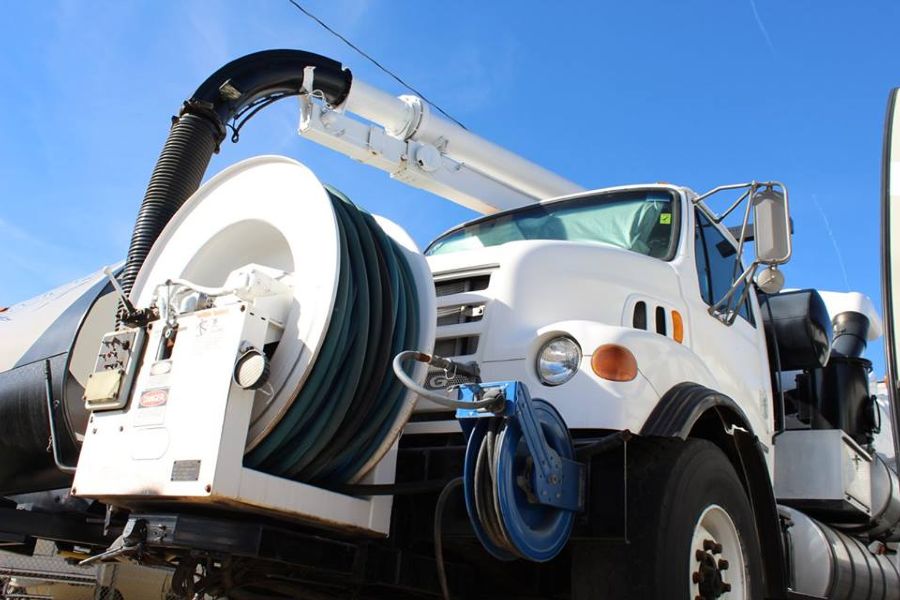
BBC Rooter & Plumbing is an underground pipe and sewer contractor based in Northridge. We come downtown for building sewers, grease lines, camera diagnostics and trenchless rehabilitation, and we are open about the fact that we operate from a Valley yard rather than a downtown office. If a kitchen is down or a building is backing up, the number is 818-280-9135.
Downtown Is City of Los Angeles Sewer Territory, and the Paperwork Reflects It
Unlike the independent cities and unincorporated pockets elsewhere in our service area, downtown sits squarely inside the City of Los Angeles. LA Sanitation and Environment operates the collection system that everything here drains into. The Department of Building and Safety handles plumbing permits. Sewer connection and capping work goes through the Bureau of Engineering, and any excavation in a public street or sidewalk brings in the street services and transportation departments as well.
That last piece separates downtown from everywhere else we work. A trench in a residential parkway is a plumbing job with a permit attached. A trench in a downtown street is a traffic control operation that happens to involve a pipe. Lane closures must be approved, work windows get pushed to nights or weekends on busy corridors, and streets carrying transit add their own constraints. A contractor who quotes a downtown excavation without accounting for that is quoting a job they have not thought through. Requirements change, so verify current process with the relevant city bureaus before a project is finalized.
A Hundred Years of Cast Iron and Clay Under Structural Concrete
The Historic Core along Broadway, Spring and Main was built out between roughly 1900 and the early 1930s, and a remarkable amount of that building stock is still standing and still in use. So is a remarkable amount of its original drainage. Inside those buildings the soil stacks and building drains are cast iron. Outside, the building sewer running to the street is typically vitrified clay.
Cast iron does not fail the way people expect. It corrodes fastest along the invert, where waste sits in continuous contact with the metal, so a stack can look sound where the camera enters and be worn to a channel forty feet along. Sewer gas attacks the crown from the other direction. The practical service life of the original iron in a 1920s building is behind it, and what we find is pipe that has lost bore to scale and lost wall at the invert at the same time.
The clay outside has the usual clay problem, which is joints, made harder by the fact that in this district the pipe is under sidewalk, under structural slab, under a basement floor or under an areaway. Downtown also has a genuine oddity worth knowing about: sub-sidewalk vaults. Many older buildings extend basement space out under the public sidewalk, which means the building sewer sometimes passes through or beside occupied structure rather than through plain dirt. That is a very different excavation conversation.
Adaptive Reuse: New Bathrooms Bolted Onto Century-Old Drainage
In 1999 the city adopted an adaptive reuse ordinance that made it dramatically easier to convert older downtown commercial buildings into housing, and the result reshaped the district. Bank buildings, office towers and department stores that had sat mostly empty became loft residential. It was good policy and it saved a lot of architecture. It also created a specific and predictable plumbing situation.
The load changed. The pipe often did not.
A 1925 office floor had a pair of restrooms. The same floor as lofts has a dozen kitchens and a dozen or more bathrooms, all discharging into stacks that were sized for the original use.
When a converted building has chronic drainage complaints that move around from unit to unit, this is usually why. It is not one broken thing. It is a system running closer to its hydraulic limit than it was ever designed to run, with the oldest and least accessible component at the bottom of it.
Grease Is the Number One Reason This Neighborhood Calls Us
Downtown has an extraordinary density of food service. Ground floor restaurants across South Park and the Historic Core, the Arts District dining strip, the food halls, hotel kitchens, commissary and catering operations, plus the wholesale food trade around the produce and seafood blocks near the Fashion District. Every one of them puts fats, oils and grease into a drainage system that was not built with them in mind.
Grease does not behave like a solid obstruction. It leaves the kitchen warm and liquid, travels until it cools, and then plates out on the pipe wall in layers. The line does not stop; it narrows. Capacity falls quietly over months until one high-volume service pushes more through than the remaining bore can carry, and the failure arrives at the worst possible hour with a dining room full of people.
Food service properties in the city are required to control that discharge, normally with a grease interceptor or trap ahead of the building sewer. Two things about that requirement get missed constantly. First, an interceptor only works if it is pumped on a schedule appropriate to the volume the kitchen actually produces; once it is loaded, grease passes straight through it and into the building lateral. Second, the interceptor does nothing for the pipe upstream of it. The run from the kitchen sinks, dishwasher and floor drains to the interceptor is where the heaviest coating occurs, and that run needs periodic hydrojetting regardless of how well the interceptor is maintained.
We handle that as scheduled maintenance rather than emergency work, because with grease the cheap version of the job is always the one done on a calendar. Verify your own service interval and record-keeping obligations with the city.
Kitchen Down or Building Backing Up? We Dispatch Downtown Every Day.
Grease line jetting, main line rooter and camera diagnosis, including after hours when a closure is on the line.
Call 818-280-9135Who Owns the Pipe in a Loft Building, and Who Pays for It
In a residential condominium or loft association, the governing CC&Rs define what is common area and what belongs to the unit. The usual pattern is that the branch drain serving only your unit is yours, while the vertical stack, the horizontal building drain and the building sewer out to the city main are common. That pattern is common but it is not universal, and we have read enough sets of downtown CC&Rs to know they are not interchangeable. In a leased commercial building, the same split lives in the lease instead, and it varies even more widely between landlords.
What that means in practice is that when sewage comes up through a ground floor floor drain or a first-level unit, the physical cause and the financial responsibility are two separate investigations. We can settle the physical one on the day of the call. A camera inspection with a footage counter tells you whether the blockage is in a unit branch, in the building drain in the garage ceiling, or seventy feet out under the sidewalk in the building sewer. Boards and property managers then take that footage and that measurement to the CC&Rs or the lease. Our advice is to get the documentation before the argument, not during it.
Stacks, Offsets and the Physics of a High-Rise Drain
Tall buildings drain differently, and the difference is not intuitive. Waste falling down a vertical stack reaches terminal velocity within a few floors and then travels as a sheet along the pipe wall with air moving in the core. It arrives at the bottom carrying real energy, and where the stack turns horizontal at the base it has to convert that vertical flow into horizontal flow. Pressure spikes at that turn, flow depth jumps, and the base of the stack becomes both the highest-stress fitting in the building and the place where solids and grease preferentially deposit.
The practical consequence for an owner or manager is that a recurring backup on the lowest levels of a building is almost never a lowest-level problem. It is the whole building arriving at one fitting. Cabling it clears the symptom. Jetting the base run and the building drain, and scoping the fitting itself, is what tells you whether the pipe still has wall left.
What Fails in the Historic Core, the Arts District, South Park and the Fashion District
Grease plating in kitchen waste lines
The dominant downtown failure. Layered fat narrows the bore invisibly until a busy service overwhelms what is left. Cabling reopens a channel through it and leaves the rest of the deposit on the wall.
Cast iron worn through at the invert
Nine decades of continuous waste contact eats the bottom of the pipe first. On camera it reads as a channel or a rough trough where a smooth half-round should be.
Textile and lint blockages
A Fashion District specialty. Thread, fabric scrap and cutting-room debris entering floor drains binds into a mat that catches everything downstream of it.
Undersized retrofit branches
Conversion-era branch lines run through ceilings and chases with minimal fall. They work until a small amount of solids or grease is enough to stall flow entirely.
Base-of-stack deposition
Where a tower stack turns horizontal, energy drops and material drops with it. Repeat blockages at the same elbow are a structural signal, not bad luck.
Clay building sewers under concrete
Original laterals to the street with open joints, root intrusion from street trees and planters, and offsets. Access means coring or saw-cutting, which is why diagnosis before demolition matters here more than anywhere.
Sewer and Underground Work We Perform Downtown
Work that belongs to a different trade
We are a sewer and underground pipe company. Water heaters and boilers, tankless units, fixtures, faucets, toilets, sinks and disposals, domestic water repiping, pinhole leaks in copper, filtration, gas piping and tenant improvement rough plumbing are not services we offer. Downtown buildings usually have a mechanical contractor or a building engineer for that scope. If your problem turns out to sit on their side of the line, we will tell you on the first visit.
How to Tell the Building Main Is the Problem
- Multiple units or multiple tenants affected at once. One unit with a slow drain is a branch. Three units on a vertical line is the stack, and the whole ground floor is the building drain.
- Backups that track occupancy. If it fails during dinner service or at the morning peak and behaves the rest of the day, the line is at its capacity limit rather than fully blocked.
- A history of repeat service on the same fitting. Three visits to the same elbow in a year is a structural finding waiting to be documented.
Coming Downtown From Northridge
Our shop is at 8635 Yolanda Avenue in Northridge. Downtown is roughly twenty-five to thirty miles depending on the address, and we run it via the 405 to the 101 or across the 118 and 5 to the 110, whichever is moving. Realistically that is forty-five minutes on a quiet morning and can be ninety in the afternoon peak. We schedule commercial work with that in mind and often start early, which suits restaurant clients who want the line jetted before prep begins.
We cover the Historic Core and the Broadway theater blocks, the Arts District east of Alameda, South Park around the arena and convention center, the Fashion District, the Financial District and the Civic Center and Little Tokyo blocks.
What Owners, Boards, Managers and Operators Ask Us
Sewage came up in my loft. Is that the building's line or mine?
It depends on your building's governing documents, not on plumbing convention. In most residential loft and condominium associations, the branch drain that serves only your unit is the owner's responsibility while the vertical stack, the horizontal building drain and the building sewer out to the city main are common area. In a leased commercial space the same division lives in the lease and varies more. What we can establish immediately is the physical location, because a camera with a footage counter shows whether the blockage is in your branch, in the shared drain overhead, or out under the sidewalk. Take that measurement to the documents.
Our restaurant has a grease interceptor. Why do the lines still need jetting?
Because the interceptor protects the sewer downstream of it, not the pipe upstream of it. Everything between your sinks, dishwasher and floor drains and the interceptor inlet is carrying warm untreated grease, and that is where the heaviest coating builds. On top of that, an interceptor that is overdue for pumping stops separating and begins passing grease straight through into the building lateral. The working answer is both: pump the interceptor on a schedule matched to your actual volume, and jet the kitchen waste runs periodically. Confirm your facility's specific requirements with the city.
Who issues the permits for sewer work in Downtown LA?
The City of Los Angeles. Plumbing permits come through the Department of Building and Safety, sewer connection and capping work goes through the Bureau of Engineering, and excavation in a public street or sidewalk requires a permit from the street services department plus an approved traffic control plan involving the transportation department. Downtown adds restrictions that residential streets do not have, including limited work windows on busy corridors. Because city procedures are revised periodically, confirm current requirements with the relevant bureau before scheduling an excavation.
Can a building sewer under a concrete slab be replaced without tearing up the floor?
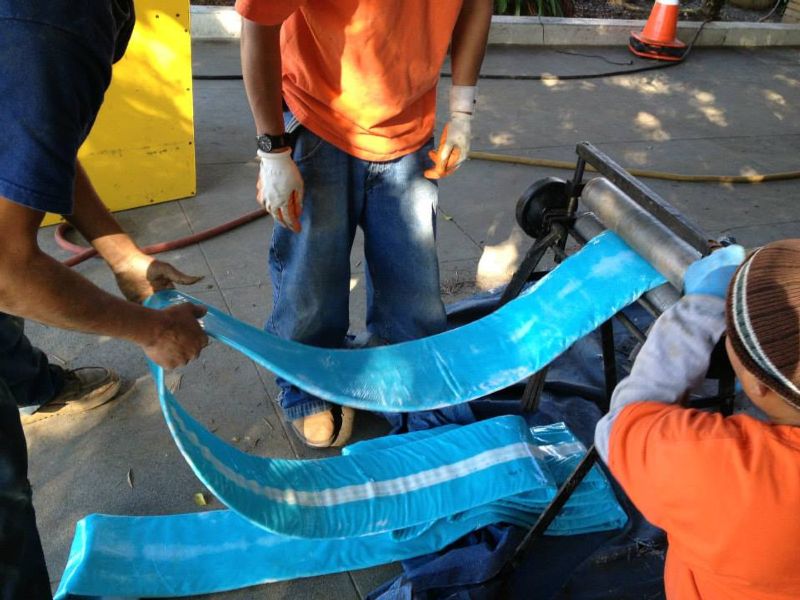
Often, yes. Cured-in-place lining pulls a resin-saturated tube through the existing pipe and cures it into a new jointless pipe inside the old one, working entirely from existing access points, which means the slab, the tile and the sidewalk above it are left alone. The condition is that the host pipe still holds its shape well enough to accept a liner. Where a section has collapsed or where cast iron has lost too much wall, we may still need a spot excavation, but the scope is usually a small opening rather than the whole run. The camera makes that call.
Why does the building only back up during peak hours?
That pattern almost always means reduced capacity rather than a complete obstruction. A pipe that has lost half its diameter to grease or scale still carries light flow perfectly well, and it only fails when the building actually loads it, which is dinner service in a restaurant or the morning rush in a residential tower. In tall buildings the failure usually shows up at the base of the stack, where vertical flow turns horizontal and material drops out. Clearing it restores service for a while. Measuring the remaining bore on camera tells you how long that while is likely to be.
How long does it take you to get downtown from Northridge?
Twenty-five to thirty miles and anywhere from forty-five to ninety minutes depending on the hour and the freeway. We have no downtown office or yard and will not imply we do. What arrives is a licensed crew under CSLB number 720343 with a jetter, a camera and the equipment to work commercial lines, seven days a week, with office hours 6am to 6pm and the emergency line answered outside them. For restaurants we frequently schedule early morning so the work is done before service.
Other Areas on the Same Dispatch
Downtown is the eastern end of a service area that reaches back across the Valley and west to the coast:
Put Your Downtown Building Sewer on Camera
Owner Babak Behzadi. CSLB #720343. Licensed, insured and working commercial lines seven days a week.
Call 818-280-9135