
Sewer Line Repair & Replacement in Northridge & the San Fernando Valley
When a sewer line fails there are only two honest answers: fix the broken part, or replace the run. Which one you need is a question the camera answers, not the person writing the quote.
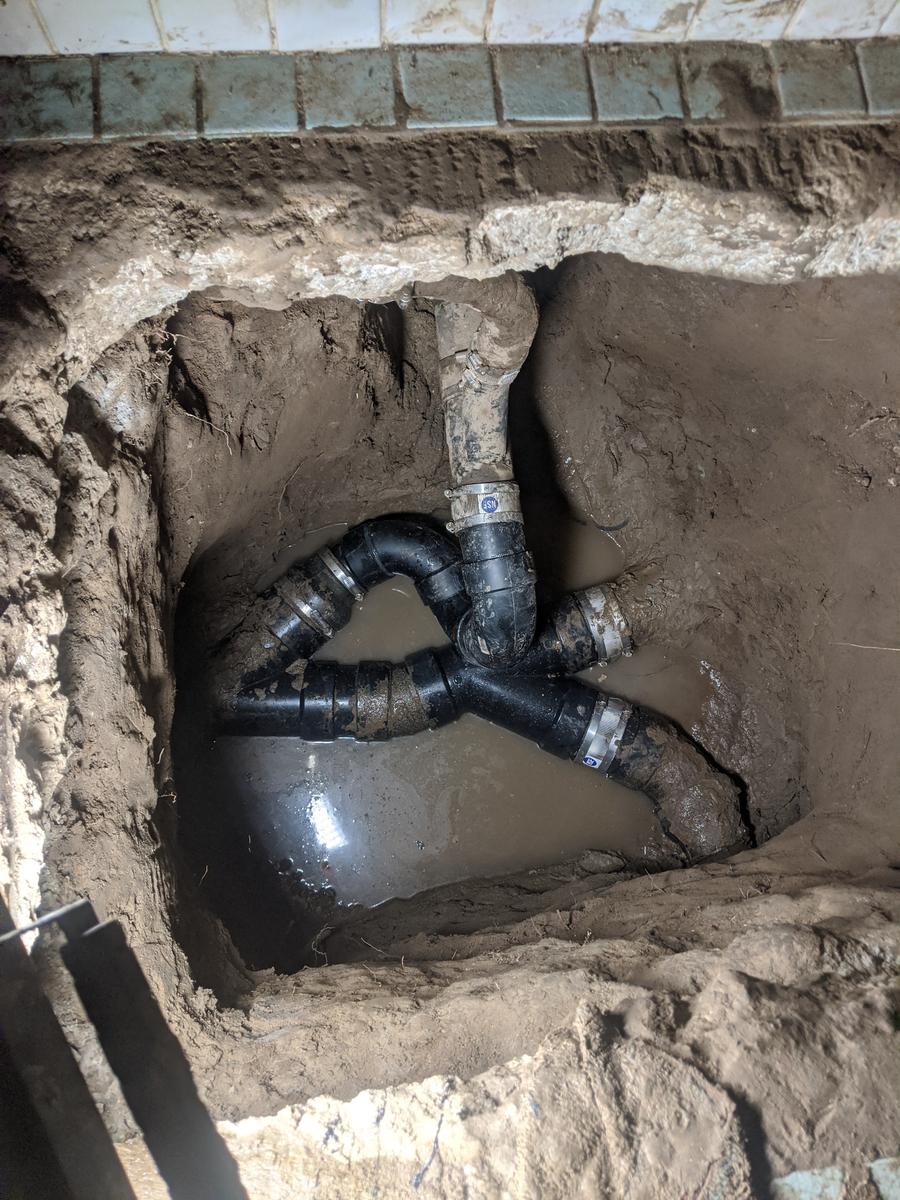
New pipe, proper bedding, correct fall. The part you never see is the part that decides whether it lasts.
What is actually in the ground under the Valley
The San Fernando Valley filled in fast. The orange groves and bean fields that covered most of it before the war were subdivided through the late 1940s, the 1950s and the 1960s, and the sewer laterals laid under those tracts are still the ones in service. When we open a line in Reseda, Van Nuys, Panorama City or the older parts of Northridge, we are usually looking at pipe that went in the ground before the Beatles landed.
Four materials cover almost everything we find, and each one fails in its own way.
- Vitrified clay. The standard for residential laterals until roughly 1970, and the most common pipe in the Valley. It is strong under compression and brittle at everything else. A four-inch lateral is a chain of short sections joined every two to three feet, and in pre-1970 work those joints are packed with mortar or oakum rather than a rubber gasket. Ground movement walks the sections out of line. Once a joint opens, roots follow the moisture in.
- Cast iron. Common in 1950s and 1960s construction, particularly the building drain under the slab. It rusts from the inside out, so the pipe looks sound from the trench while the wall thickness is already gone. By the time a camera shows holes, the whole run is usually at the same age.
- Orangeburg. Bituminized wood fibre, essentially tar-impregnated paper wound into a tube, used in the post-war building boom when cast iron was scarce. It deforms into an oval under load and then collapses. There is no repairing it. If your camera shows Orangeburg, budget for replacement.
- ABS and PVC. Standard from the 1970s onward and rarely a problem on its own. When modern pipe fails it is almost always the bedding, not the pipe: poor compaction under the barrel, a belly, or somebody else's excavation.
What the 1994 earthquake left in the pipe
On 17 January 1994 a blind thrust fault ruptured under the Valley floor. Buildings were retrofitted afterward and freeway spans were rebuilt, but almost nobody went back and looked at the buried clay.
Clay pipe cannot flex. When the ground moved, the short sections either pulled apart at the joints or stepped out of round, and some reaches settled out of grade relative to the run on either side. Very little of that failed on the day. It failed slowly, and it is still failing. An offset joint leaks a small amount of moisture into the soil, roots find the damp, the roots widen the opening, paper and grease catch on the root mass, and fifteen or twenty-five years later somebody calls because the tub fills up when the washing machine drains.
When we scope a line in this part of the Valley and see stair-stepped offsets at several joints in a row rather than one isolated break, that is usually what we are looking at, and it changes the recommendation. One offset is a spot repair. A run of them is a line that has been moving.
Two failures that have nothing to do with the material
A belly is a low spot where the pipe has sagged and standing water sits in it instead of flowing through. It is almost always poor compaction under the pipe when it was laid, and it shows on camera as a pool the crawler drives into. Cleaning a belly does nothing, because the low spot is still there the following week. Fixing it means excavating that reach and re-laying it to grade.
An offset joint is two sections shifted out of line, so the edge of one catches everything passing through it. A small offset is a maintenance problem. A large one is a repair, and once it is wide enough for roots it is a repair regardless.
Spot repair, or the whole line?
The answer changes the price by ten times or more, so it deserves evidence.
A spot repair is right when the camera shows sound pipe with one failed section. A crack, a collapsed spot, a single offset joint. We open one small excavation, cut out the bad piece, and put in new.
Replacement is right when the run is failing along its length: multiple root-opened joints, cast iron with the wall rusted through, Orangeburg, or a belly that has to be re-graded. Patching one spot on a line like that buys months, and you pay the mobilisation and the restoration twice.
The honest version of this conversation involves showing you the video and explaining what you are looking at. If a contractor quotes you a full replacement and cannot or will not show you the line, that is the moment to get a second opinion.
The three ways we do the work
| Method | What happens | Best when | What it does to your yard |
|---|---|---|---|
| Open trench | Dig down to the line, take out the failed pipe, lay new pipe on proper bedding with correct fall, backfill and compact, restore the surface. | Collapsed pipe, a belly that needs re-grading, shallow lines, or where new cleanouts are going in anyway. | A trench the length of the repair, then restoration. |
| Pipe lining (CIPP) | A resin-soaked liner is pulled through the old pipe and cured hard, forming a new pipe inside it. | Pipe that is cracked or root-opened but still holds its shape and fall. Ideal under driveways, patios and mature landscaping. | Small pits at the access points. The ground in between is never opened. |
| Pipe bursting | A bursting head is winched through, cracking the old pipe outward while pulling new pipe in behind it. | Pipe too far gone to line, where a full-length trench is not practical. | An entry pit and a pulling pit. |
Both trenchless methods are covered in more detail on the trenchless sewer repair page. Neither is magic, lining needs a pipe that still holds its shape, and bursting needs a clear path and room for the pits. We camera the line before recommending either.
What a proper replacement includes
Most of what separates a repair that lasts thirty years from one that fails in five is invisible once the dirt is back. Any quote you accept, ours or anyone else's, should list the following.
- Camera inspection first, with video you keep, so the scope is based on the actual condition of the line
- Locating and marking before excavation, depth and position, plus a utility mark-out so nobody hits a gas or water line
- Permits pulled with the jurisdiction and the inspection coordinated
- Correct fall. too flat and solids stand still, too steep and water runs away and leaves them behind. Fall is the thing most often got wrong on a cheap job.
- Proper bedding and compaction under and around the pipe. Pipe laid straight on rock or loose fill is how you get a belly two years later.
- A cleanout where one is missing, so the next diagnosis does not cost extra
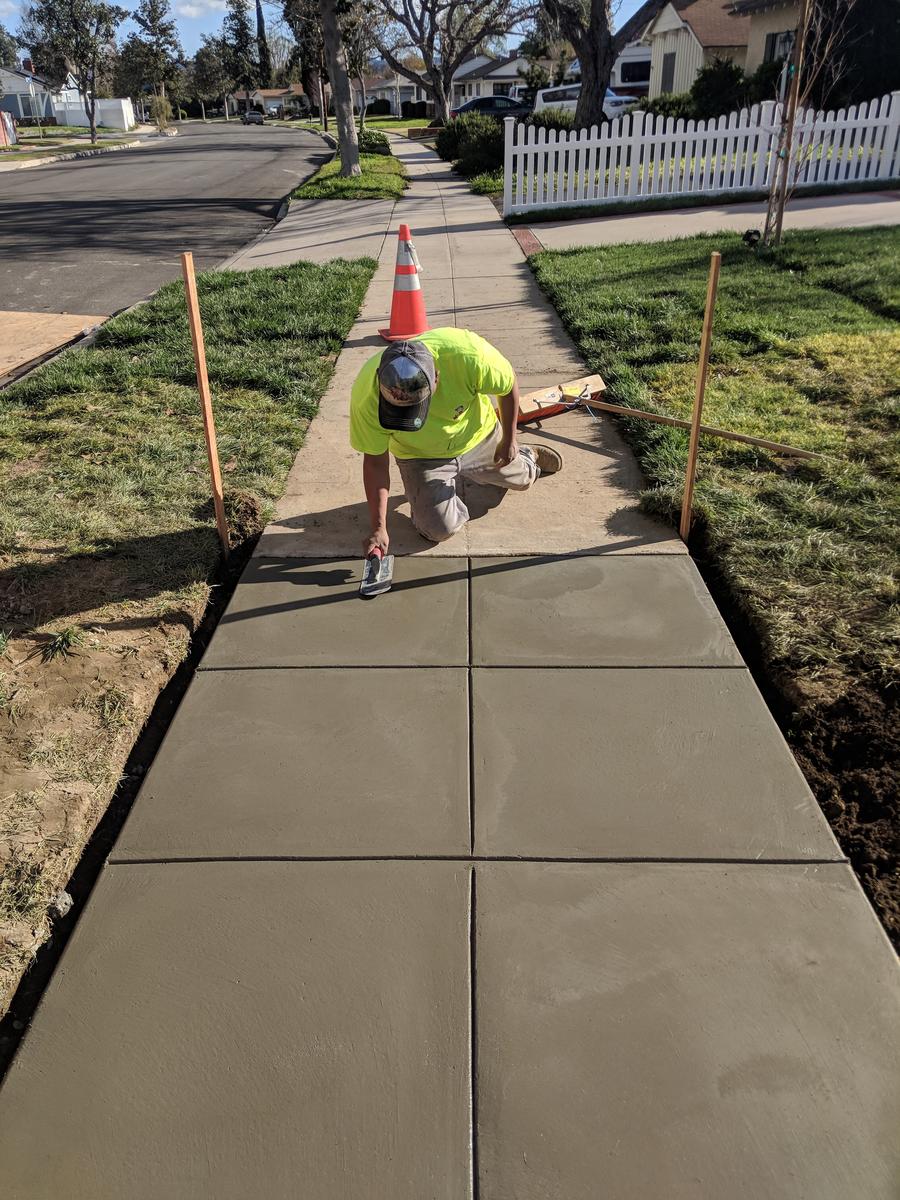
- Surface restoration. concrete, asphalt, hardscape and landscape put back, not left as a dirt patch
- A camera run at the end, so you can see what you paid for
What it costs
We will not put a number on this page, because anyone who does is guessing. What we can do is tell you what moves it, so you can read a quote properly:
- Length and depth of the run. Depth matters more than length. A deep line means a wider, shored excavation.
- What is on top. Grass is cheap. A driveway, a mature tree, a poured patio or a finished floor is not, and that is usually where trenchless pays for itself.
- Access. Whether a machine can reach the line, or it has to be dug by hand.
- Method. Lining, bursting and open trench price differently, and the cheapest method is not the cheapest job once restoration is counted.
- Permits and inspection in the jurisdiction you are in.
- Whether the city portion is involved. work in the street or at the main is a different permit and a different scope.
Ask any contractor to itemise those. A single lump sum with no breakdown is not a quote, it is a number.
Will insurance pay for it?
Usually not for the pipe itself. Standard California homeowner policies treat a failed sewer line as wear and tear, which is excluded. What they often do cover is the resulting damage, water in the house, flooring, drywall, and some policies have a service line endorsement you may have bought without noticing. It is worth reading your declarations page before assuming either way. We write up findings in plain terms so you have something to submit.
Signs your line is heading for this
- More than one fixture backing up at the same time
- The same clog returning every few months in the same place
- Gurgling from a toilet when the washing machine drains
- Sewer smell in the yard, or a patch of grass that is greener and always damp
- A slab-on-grade house where the floor is warm or damp in one spot
- An older house you are about to buy and have not scoped, see camera inspection
Get it looked at
- Phone
- 818-280-9135, seven days a week, emergency line 24 hours
- Where we work
- Northridge and the San Fernando Valley, see service areas
- License
- CSLB #720343
Common questions
How long does a sewer line replacement take?
A straightforward residential lateral is often one to two days for the pipe work, plus restoration. Depth, access and permit inspection scheduling move it more than length does.
Will I be able to use the bathroom while you work?
For most of the job, no. The line is open. We plan the cut-over so the house is out of service for as short a window as possible, and we tell you before we start rather than after.
Do I have to replace the whole line if only one part is broken?
No, and you should be sceptical of anyone who says otherwise without video. One failed section in sound pipe is a spot repair.
Can you replace the pipe without digging up my driveway?
Often, with lining or bursting. It depends on whether the existing pipe still holds its shape and whether there is room for access pits at each end. The camera tells us before we promise.
Who pays for the part under the sidewalk or parkway?
You do, in most of the Valley. Your responsibility usually runs all the way to the connection at the city main, including the portion under the parkway strip and sidewalk. The city owns the main itself.
Do you guarantee the work?
Yes, and the terms go in writing on the quote rather than being described on a website. Ask when we come out.
What if you open it up and it is worse than the quote?
We stop and show you before doing anything that changes the price. A camera survey up front is what keeps that from happening, so we do one first.
Related: trenchless sewer repair · camera inspection · root intrusion removal · all services