
Root Intrusion Removal, Getting Tree Roots Out of a Sewer Line
Roots are the number one cause of sewer blockages in the San Fernando Valley. Cutting them out is the easy half. Keeping them out means dealing with the reason they got in, and most contractors skip that conversation.
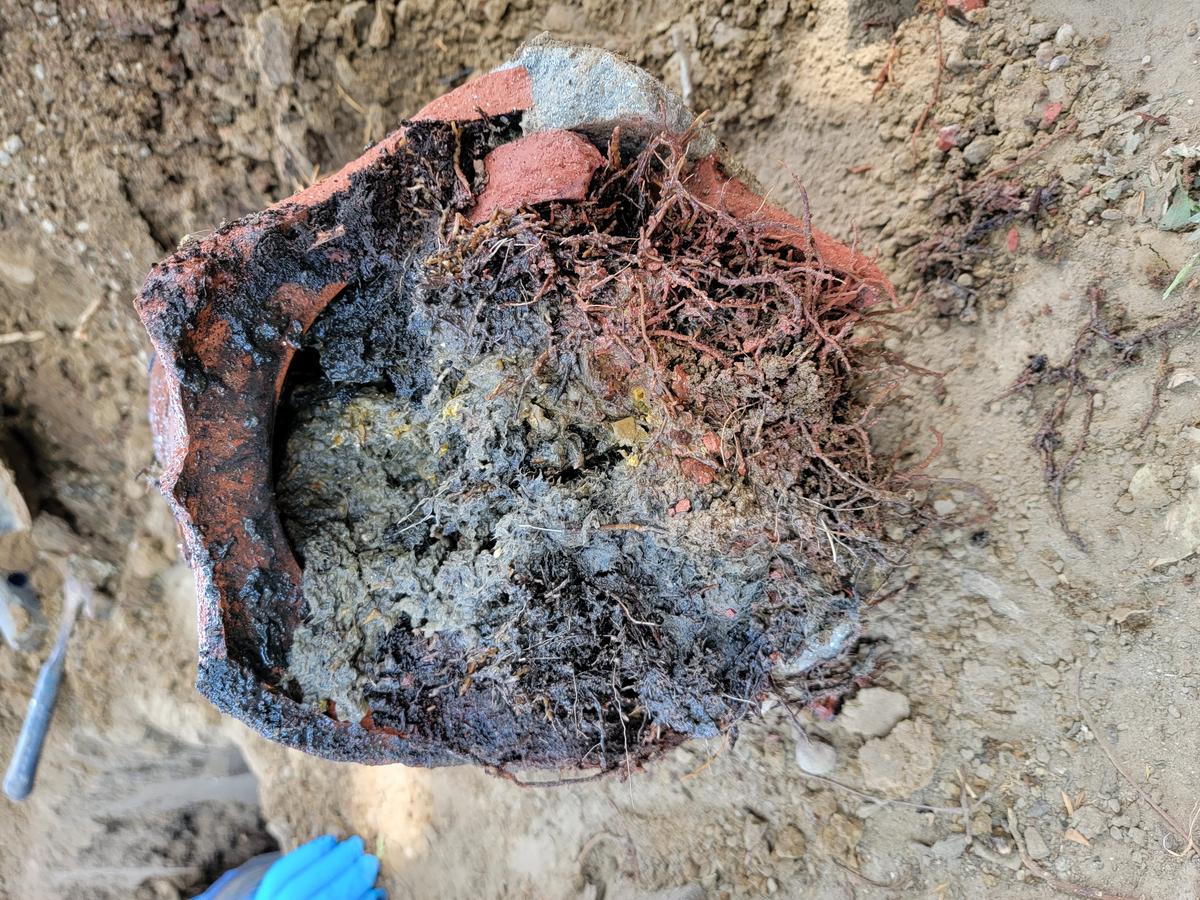
This is what a "slow drain" looks like once the pipe is opened up.
Roots do not break into a healthy pipe
A sewer line is not a food source a tree goes hunting for. What a root follows is moisture and the warm, nutrient-rich vapour escaping from a joint that has already shifted, cracked or lost its seal. The pipe fails first. The root is the consequence.
Once a hair-thin root gets through that gap it is inside a pipe that offers everything a root wants: water, nutrients and no competition. It thickens year after year, and as it thickens it acts like a wedge, widening the very crack it came through.
That progression is why the timing feels so sudden to homeowners. For years there is nothing to notice. Then the mass reaches the point where it catches toilet paper and grease, and what was invisible becomes a backup in a matter of weeks.
Why the San Fernando Valley is bad for this
Three things stack up here, and they arrived in a particular order.
First, the pipe. Most Valley housing predates 1970, which means vitrified clay laid in short sections with a mortared joint every two to three feet. A hundred-foot lateral can have forty opportunities for a seal to go.
Second, the trees. The tracts that went up through the 1950s and 1960s were planted with street trees at the same time, and those trees are now sixty and seventy years old with root systems to match. In Reseda, Van Nuys, Panorama City and the older streets of Northridge the parkway planting sits directly over the lateral, because that is where the easement was.
Third, the climate. Los Angeles goes months without meaningful rain. For most of the year the wettest thing in the soil under a Valley front yard is the sewer line, and a root system that finds a damp joint in August has no reason to look anywhere else.
Ficus, liquidambar, silver maple, magnolia and eucalyptus are the repeat offenders in our service area. A mature ficus in a parkway strip over a clay lateral is close to a guarantee of this job eventually, and we have replaced the same stretch of pipe on the same block more than once for different owners.
The 1994 earthquake made it worse. Ground movement that day walked clay joints out of line across this side of the Valley, and every joint that opened even slightly became an invitation. Much of the root intrusion we cut out today is growing through a gap that was created in seventeen seconds thirty years ago.
How we get them out
Mechanical cutting
A cutting head on a cable is run down the line and spun, shearing the root mass off at the pipe wall. It is fast, it restores flow, and on a line that is otherwise sound it is often all that is needed to get through to a planned repair. What it does not do is remove the root outside the pipe, which is still alive and will grow back in through the same gap.
Hydrojetting
High-pressure water with a root-cutting head does a more thorough job. It shears the roots and scours the pipe walls back to bare pipe, taking the grease and scale that the root mass was catching along with it. A jetted line stays open considerably longer than a cut one because there is nothing left on the walls for the next growth to grab. See hydrojetting.
Camera first, camera after
Before we cut anything we want to know what we are cutting into. A root mass in sound pipe and a root mass in a pipe that is already cracked open need different follow-up. Afterwards, the camera tells you whether the pipe under all that growth is intact or whether the roots have been holding a broken joint together. That second run is the one that matters, and it is the one most often skipped.
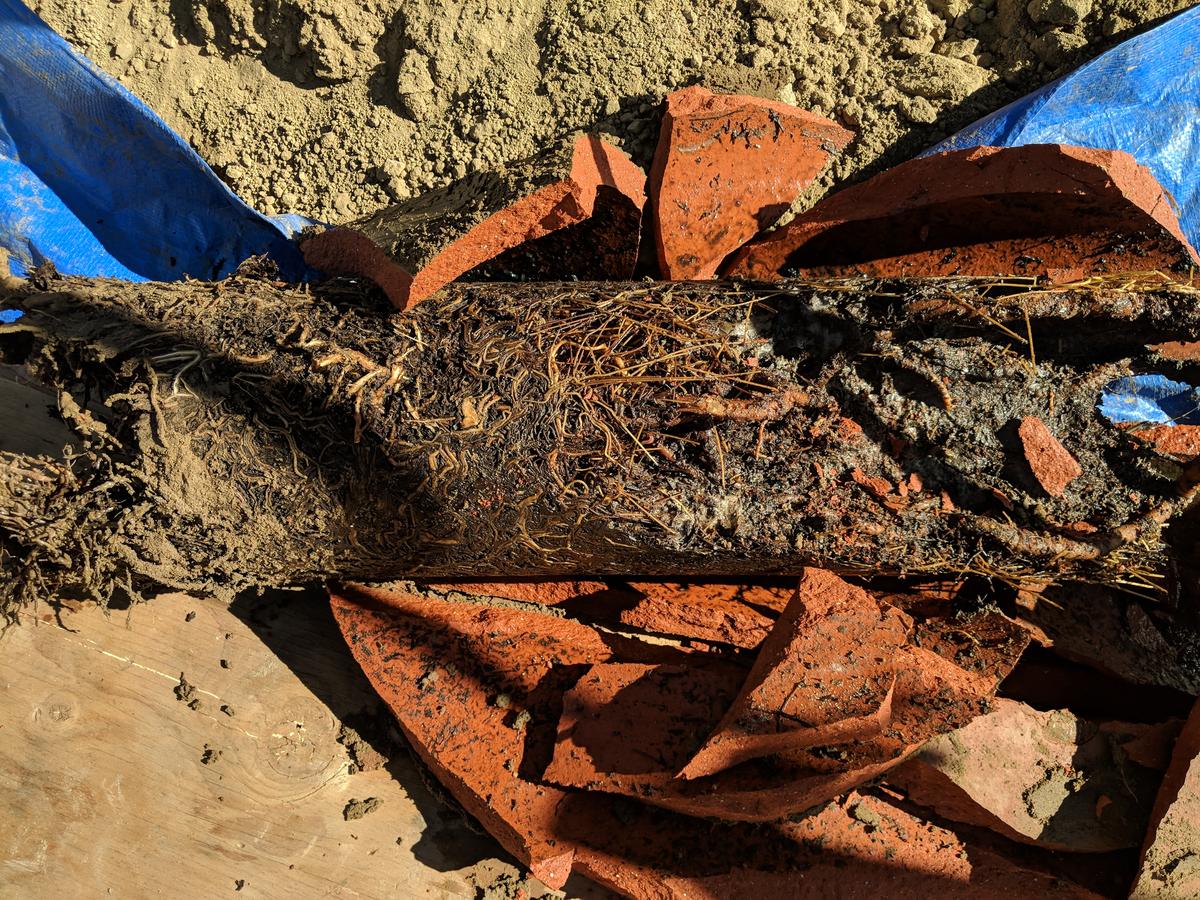
Cutting is maintenance, not a repair
Cutting roots out and calling it a repair is how a contractor sells the same visit every eighteen months. Mechanical cutting and jetting remove what is inside the pipe. The gap that let the root in is still there, and the root outside is still alive. Regrowth is not a possibility, it is a schedule.
Choosing that is fine. Some lines get cut on a routine and never cause trouble. But you should be choosing it knowingly, not because nobody told you the pipe was broken.
What actually ends it
- Lining the pipe (CIPP). A cured liner seals every joint along the run, so there is no gap left to grow through. It is the usual permanent answer for a root-plagued but structurally intact line. See trenchless repair.
- Replacing the section. If the roots have already cracked the pipe open, a spot repair or replacement with modern jointed pipe removes the failure and the entry point together.
- Root-inhibiting foam as a stopgap. Applied after cutting, it slows regrowth at the joint. It buys time. It does not fix a broken pipe, and we will not present it as if it does.
- Removing the tree works and is almost never worth it. A mature shade tree is worth more to a property than the pipe repair costs.
Signs roots are already in your line
- Gurgling from a toilet when a tub or washing machine drains, air being pushed past a partial blockage
- The same slow drain returning every year or two, usually in the wetter months
- Multiple fixtures slow at once, which points at the main rather than a fixture arm
- A patch of lawn over the line that is greener and damper than the rest
- A backup that clears with a snake and returns within months
- Mature trees within about twenty feet of the line's path
Get the line cleared and looked at
- Phone
- 818-280-9135, seven days a week, emergency line 24 hours
- What we will tell you
- Whether this is a cut-and-maintain line or a broken one. With video, either way.
- License
- CSLB #720343
Common questions
How often do roots grow back?
After mechanical cutting, commonly within one to two years in this area. After jetting, longer, because there is less material left on the walls for new growth to catch on. After lining or replacement, not at all, because the entry point is gone.
Do chemical root killers work?
Copper sulphate and similar products kill root tissue they contact, which is a small fraction of the mass, and they do nothing about the gap. Foaming herbicides applied professionally after cutting do better and still only slow regrowth. Neither fixes a cracked joint.
Will cutting the roots damage my tree?
No. We are removing the portion growing inside the pipe, which is a small part of a mature root system.
Can roots actually break the pipe, or do they just block it?
Both. They enter through an existing gap, then thicken and act as a wedge that widens it. On clay pipe that regularly ends in cracked and displaced sections.
My neighbour's tree is over my line. Whose problem is it?
The pipe is yours, so the repair is yours, regardless of whose tree it is. Legal responsibility for tree damage is a question for a lawyer, not a plumber, but the practical answer is that the line still has to be fixed.
Is it worth cutting roots before selling the house?
Clearing the line helps. Be aware that a buyer's inspection camera will still see the cracked joint the roots came through, so a clean line is not the same as a clean report. See pre-purchase camera inspection.
Related: hydrojetting · sewer line repair & replacement · drain & sewer cleaning · all services