
Trenchless Sewer Repair in Northridge & the San Fernando Valley
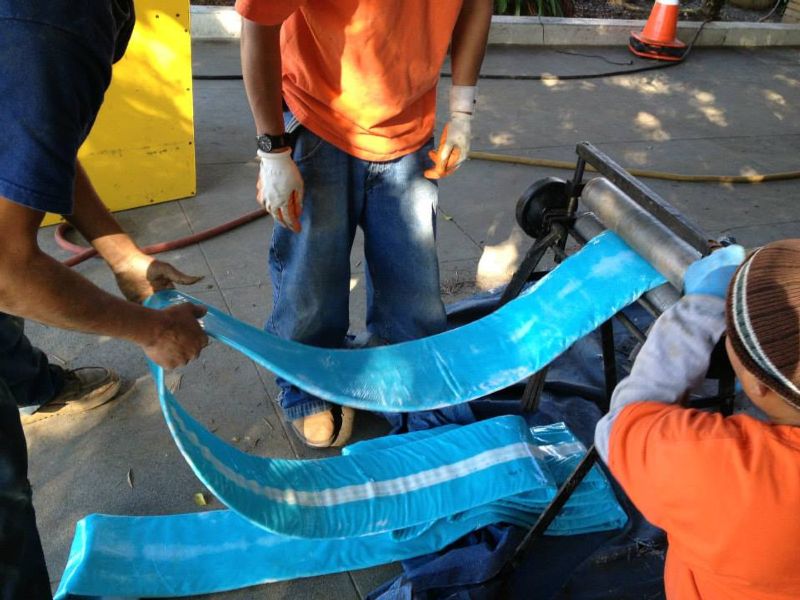
Trenchless sewer repair fixes damaged underground sewer lines without tearing up your yard, driveway, or landscaping. Instead of digging a trench along the entire pipe run, trenchless methods work from one or two small access points, saving you thousands in restoration costs and days of disruption.
BBC Rooter & Plumbing performs trenchless sewer repairs across Northridge, Woodland Hills, Chatsworth, Granada Hills, Encino, and every community in the San Fernando Valley. We handle both major trenchless methods in-house: pipe lining (CIPP) and pipe bursting.
Pipe Lining (CIPP, or Cured-in-Place Pipe)
Pipe lining repairs your existing sewer line from the inside. A flexible tube coated with epoxy resin is pulled through the damaged pipe, inflated against the pipe walls, and cured with heat or UV light. The result is a smooth, jointless new pipe inside the old one.
Because the cured liner has no joints, there are no gaps for tree roots to re-enter, the most common cause of sewer failure in the Valley, where mature ficus, pepper trees, and magnolias send roots into aging clay pipe joints.
- Best for: Cracked pipes, root intrusion damage, offset joints, moderate corrosion, and pipes that still hold their general shape
- Works on: Clay, cast iron, Orangeburg, ABS, and PVC pipes from 3″ to 12″ diameter
- Timeline: Most residential jobs are completed in 4 to 8 hours
- Lifespan: 50+ years
Lining has more conditions attached than most companies admit, and the conditions are where the money goes wrong. Our sewer pipe lining page goes through the full day, what the liner will and will not correct, and the per-foot pricing in plain numbers.
Pipe Bursting
When a sewer line is too far gone for lining, whether severely collapsed, badly misaligned, or undersized — pipe bursting replaces it entirely without a trench. A bursting head is pulled through the old pipe, fracturing it outward while dragging a new HDPE (high-density polyethylene) pipe into place behind it.
- Best for: Collapsed lines, severely deteriorated cast iron or Orangeburg, and upsizing a pipe (e.g., 3″ to 4″)
- Works on: All residential and commercial sewer pipe materials
- Timeline: Typically one day for a standard residential lateral
- Lifespan: 50+ years — HDPE is corrosion-resistant with fused joints
How We Determine Which Method You Need
Every trenchless job starts with a sewer camera inspection. The camera footage tells us the pipe material, diameter, depth, damage type, and whether the line maintains enough structural integrity for lining or needs full replacement via bursting.
In some cases, a combination approach works best: bursting a heavily collapsed section while lining the rest of the run. We evaluate each job individually and recommend the most cost-effective solution for your specific line condition.
Why San Fernando Valley Homes Are Prime Candidates
Most homes in the Valley were built between the 1940s and 1970s with clay or cast iron sewer laterals. These pipes were designed to last 40 to 60 years — meaning the majority have now exceeded their intended lifespan. When you combine aging infrastructure with the aggressive root systems common in SFV neighborhoods, sewer line failure is a question of when.
Common signs your sewer line needs attention:
- Recurring backups or slow drains throughout the house
- Gurgling sounds from toilets when other fixtures drain
- Sewage odors inside or near the foundation
- Unexplained wet or sunken spots in the yard
- Multiple drain issues that started around the same time
If you are experiencing any of these, a camera inspection is the first step. We will show you the video footage, explain exactly what is happening in the line, and give you a written estimate on the spot.
Not sure if your problem is a bellied line or an offset joint? They look similar on camera but call for different fixes — see our guide to bellied sewer lines vs offset joints in the San Fernando Valley before committing to a repair method.
Permitting is the step that catches most homeowners out on a sewer job in the city. Our guide to sewer line permits in Los Angeles and the San Fernando Valley explains what is required, who pulls it, and how long inspection adds.
What pipe bursting actually costs you above ground
Bursting is sold as no-dig, and next to an open trench it is. It still needs two pits. One goes at the house end, usually at or near the cleanout, and one at the far end where the new pipe is pulled through to meet the city connection. Each is roughly four feet by four feet and as deep as the line, which in the Valley is commonly three to six feet.
Where those two pits land decides how the day feels. A pit in a lawn is nothing, and on the deep Encino and Tarzana lots south of Ventura Boulevard there is usually room to put both somewhere harmless. A pit through a driveway apron or a stamped concrete walkway means saw cutting and a patch, and the patch will not match. We walk the route with you and mark both locations before anything starts, because a homeowner who finds out at 8am that the pit is going through the new pavers is a homeowner who is right to be annoyed.
Underground, the burst leaves the old pipe where it is. It gets fractured outward into the surrounding soil and stays there. On a tight easement with other utilities close by, that displacement matters, and it is a reason we sometimes recommend an open cut on a short run instead. Gas, water and any low-voltage line in the corridor get located first.
Going up a pipe size
Bursting is the only trenchless method that can leave you with a bigger pipe than you started with. A three inch lateral going to four inch, or four to six on a small commercial building, happens in the same pull.
It earns its cost in three situations we see regularly. A house that has been added onto, where a 1950s three inch lateral is now serving two extra bathrooms it was never sized for. A duplex or triplex conversion sharing one original single-family lateral, which we see constantly in Van Nuys, Panorama City and North Hollywood. And a restaurant or commercial kitchen where the existing line simply cannot carry the load, which is a different conversation involving grease management as well as pipe diameter.
It is money wasted on a standard single-family house with a four inch line that has adequate fall. A four inch lateral carries a normal household with room to spare. If somebody is pushing you to upsize a healthy four inch line, ask them what problem it solves.
What we cannot do without digging
Being straight about the limits is more useful than a list of everything trenchless can do.
- A belly. Neither method fixes a low spot holding water. Lining copies it. Bursting follows the same path through the same soil and generally reproduces it. A belly is a grade problem, and grade is fixed by digging and re-bedding the pipe.
- A reroute. If the line needs to take a different path, around a new structure, away from a tree that is going to stay, that is an open trench on the new alignment.
- A line under a structure. Laterals running beneath an addition or a slab need their own assessment. Sometimes the answer is to abandon the run and take a new one around the outside.
- An unknown. If the camera cannot get through and the locator cannot confirm where the line goes, no honest quote exists yet. We find the line first.
Across Northridge, Reseda, Chatsworth and Winnetka, roughly one job in five that calls us asking specifically for trenchless ends up being better served by a conventional repair or replacement, or by a spot repair on a single bad section rather than doing the whole run. We would rather say that on day one.
How long the whole thing takes, start to finish
| Stage | Typical time | What is happening |
|---|---|---|
| Camera inspection and locate | 1 to 2 hours | Diagnosis, measurement, method decision. You see the footage. |
| Written estimate | Same visit | Priced off what the camera found, not off a phone description. |
| Permit | 1 to 5 business days | City of Los Angeles plumbing permit. We pull it. |
| Line cleaning | 1 to 4 hours | Cutting and jetting. Longest on scaled cast iron. |
| Lining or bursting | Most of one day | Sewer out of service during this window. |
| Inspection sign-off | 1 to 3 days after | City inspector. We meet them. |
| Backfill and surface repair | Same day to 1 day | Pits closed and compacted. Hardscape patching where applicable. |
Emergencies compress this, and BBC Rooter answers the phone at 818-280-9135 around the clock for them. If sewage is on a floor right now, the first job is getting the line flowing, which is usually a cable or jetting call, and the permanent repair is scheduled after. Nobody should be waiting on a permit while a house is backing up.
Valley conditions that drive this work
Three things make San Fernando Valley laterals fail on a fairly predictable schedule.
Age and material. The building wave that filled the Valley ran from roughly 1946 into the 1970s, and vitrified clay in four and five foot sections was the standard lateral of that era. Clay was a sound choice and much of it is still serviceable, but it has a joint every few feet and those joints were sealed with mortar. Sixty to eighty years on, most of them have opened at least slightly.
Trees. The Valley street tree palette leans heavily on ficus, sycamore, magnolia, pepper and carrotwood, all aggressive rooters, all planted in Los Angeles parkways directly above the lateral corridor. A root does not break into sound pipe. It finds an open joint and grows through the gap, then thickens until it is the blockage.
Ground movement. The January 1994 earthquake was centered in this Valley, and it shifted soil unevenly across whole neighborhoods. Offset joints we still find on camera in Northridge, Granada Hills, Reseda and Sherman Oaks date from that event. An offset that has been passing waste for thirty years can start catching solids the moment anything else narrows the bore.
None of that is unusual or alarming. It is the normal condition of sixty-year-old infrastructure, and it is why a camera inspection before a home purchase in this area is money well spent rather than an upsell.
Free Sewer Camera Inspection with Repair
BBC Rooter provides camera inspections to diagnose your sewer problem accurately before any work begins.
Call 818-280-9135Frequently Asked Questions
How much does trenchless sewer repair cost in the San Fernando Valley?
Most residential trenchless repairs cost between $4,000 and $15,000, depending on the pipe length, diameter, depth, and method used. Pipe lining typically runs $80 to $250 per linear foot. We provide free estimates after a camera inspection so pricing reflects your actual line condition.
Will trenchless repair work on my clay or cast iron pipes?
Yes. Both pipe lining and pipe bursting work on clay, cast iron, Orangeburg, and ABS pipes. A camera inspection determines which method is the best fit based on the current condition of your line.
How long does trenchless sewer repair last?
Both CIPP pipe lining and HDPE pipe bursting are rated for 50 years or more. The jointless design eliminates the weak points where roots and ground shifting cause failures in traditional pipe.
Do I need a permit for trenchless sewer repair in Los Angeles?
Yes. The City of Los Angeles requires a plumbing permit for sewer line repair or replacement, including trenchless methods. BBC Rooter handles all permitting as part of the job.
Other Sewer Services
Trenchless repair is one part of what we do. Depending on your situation, you may also need:
- Sewer Pipe Lining (CIPP) — the lining method in full detail, including what rules it out
- Sewer Line Repair & Replacement — when an open cut is genuinely the right call
- Hydrojetting — high-pressure water cleaning to clear roots, grease, and mineral buildup
- Sewer Camera Inspection — video diagnosis before repair or for home purchases
- Drain Cleaning & Rooter Service — clearing main line and branch drain clogs