
City of Los Angeles Sewer Inspection & Repair Contractor
The City of Los Angeles owns more than 6,700 miles of sewer. A big share of it runs under the San Fernando Valley, and our yard sits on top of it at 8635 Yolanda Avenue in Northridge, inside the city limits. We run CCTV inspection, jetting and sewer repair for LA Sanitation work, for the primes who hold the city's on-call contracts, and for the consultants who need clean video of a city line.
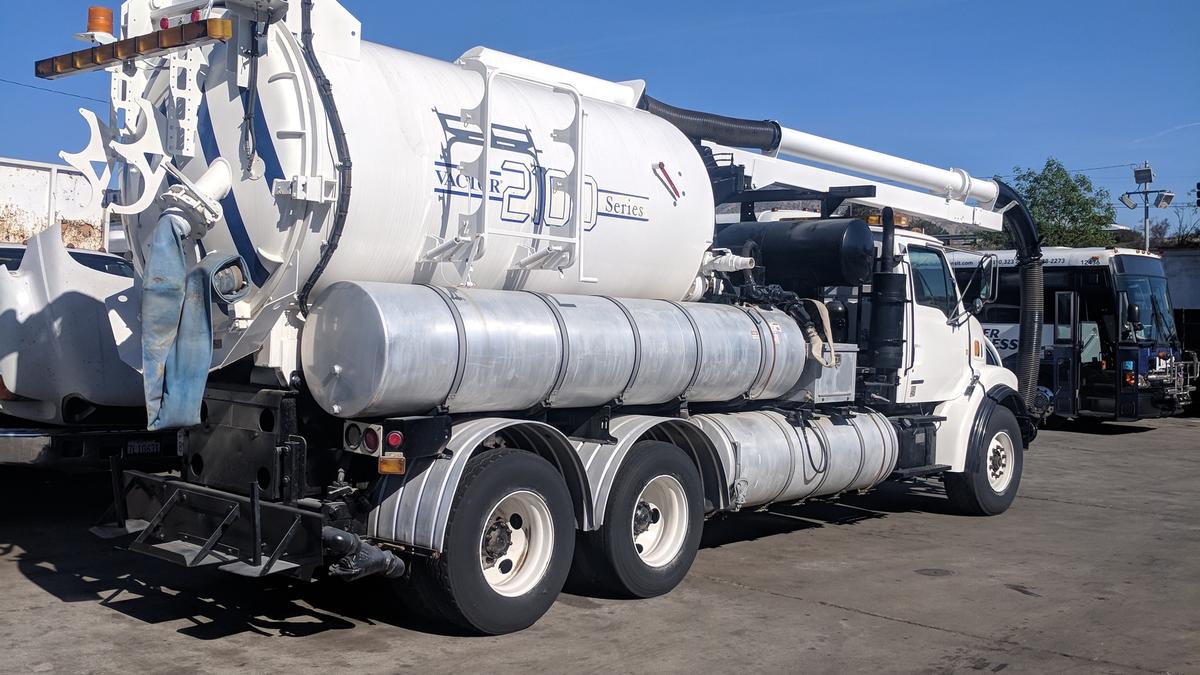
Camera, jetter and repair crew out of Northridge. Most Valley addresses in the city are under 30 minutes away.
How the city's sewers are laid out in the Valley
Most Valley street sewers are 8-inch vitrified clay laid in the 1950s and 1960s, when the orange groves and walnut orchards between Reseda Boulevard and Balboa Boulevard were being cut into tract lots. A Los Angeles Planning environmental report for a project at Roscoe Boulevard and Tobias Avenue in Panorama City lists exactly that under the street: an 8-inch clay main and a 12-inch line beside it. It is a fair picture of the whole Valley floor.
Those local mains feed larger trunk and interceptor sewers that run south and east. Wastewater from the Valley goes to one of the city's four plants:
- Donald C. Tillman Water Reclamation Plant, in the Sepulveda Basin in Van Nuys. Opened in 1985, it treats about 80 million gallons a day. Its clean water fills the lake at Lake Balboa Park and makes up most of the flow in the Los Angeles River below it. The Japanese Garden by Koichi Kawana sits on the same site.
- Los Angeles-Glendale Water Reclamation Plant, on the river by Griffith Park, owned together with the City of Glendale.
- Hyperion, in Playa del Rey. It is built for 450 million gallons a day and takes whatever the upstream plants do not.
- Terminal Island, which serves the harbor and not the Valley.
The system is still growing. In January 2019 LA Sanitation filed notice for the East West Valley Interceptor Sewer, about six miles of new pipe under Victory Boulevard between Vineland Avenue and Haskell Avenue. It will move North Hollywood flow west to Tillman instead of sending it through older lines toward Glendale.
Why the city inspects so much pipe on camera
In 1998 Santa Monica Baykeeper sued the city over sewage spills. The EPA, the Los Angeles Regional Water Quality Control Board and a coalition of community groups filed their own case in 2001. The city had logged more than 4,500 spills since 1994, many of them from roots, grease and broken clay pipe.
The cases settled in August 2004. The city agreed to about $2 billion of work over ten years, including rebuilding at least 488 miles of sewer, cleaning 2,800 miles a year, and tighter grease rules for restaurants. You cannot pick the right 488 miles without looking inside the pipe first. That settlement is a big part of why video inspection and condition grading became normal practice at LA Sanitation.
The Valley also carries damage from the January 17, 1994 Northridge earthquake. The shaking cracked clay bells and pulled joints apart all over the Valley floor. A lot of that damage never showed up as a backup. It only shows on camera, as an offset joint or a crack at twelve o'clock, 30 years later.
Who does what at the city
If you are new to city work, or you are a prime trying to figure out who signs off on what, this is the short version.
- LA Sanitation and Environment (LASAN) runs and maintains the collection system and the plants. Most inspection, cleaning and maintenance work traces back to them.
- Bureau of Engineering designs and bids the capital projects and issues permits for digging in the street.
- Bureau of Contract Administration inspects construction in the public right of way and checks prevailing wage on city contracts.
- LA Department of Building and Safety permits the building sewer on private property, from the house or building out toward the street.
One detail that causes arguments on city jobs: in Los Angeles the property owner owns the whole lateral, from the building to the connection at the city main. When a camera run shows a root ball at the connection, it matters who is paying. We log the footage mark and the clock position so that question is answered by the video, not by opinion.
What we do on city work
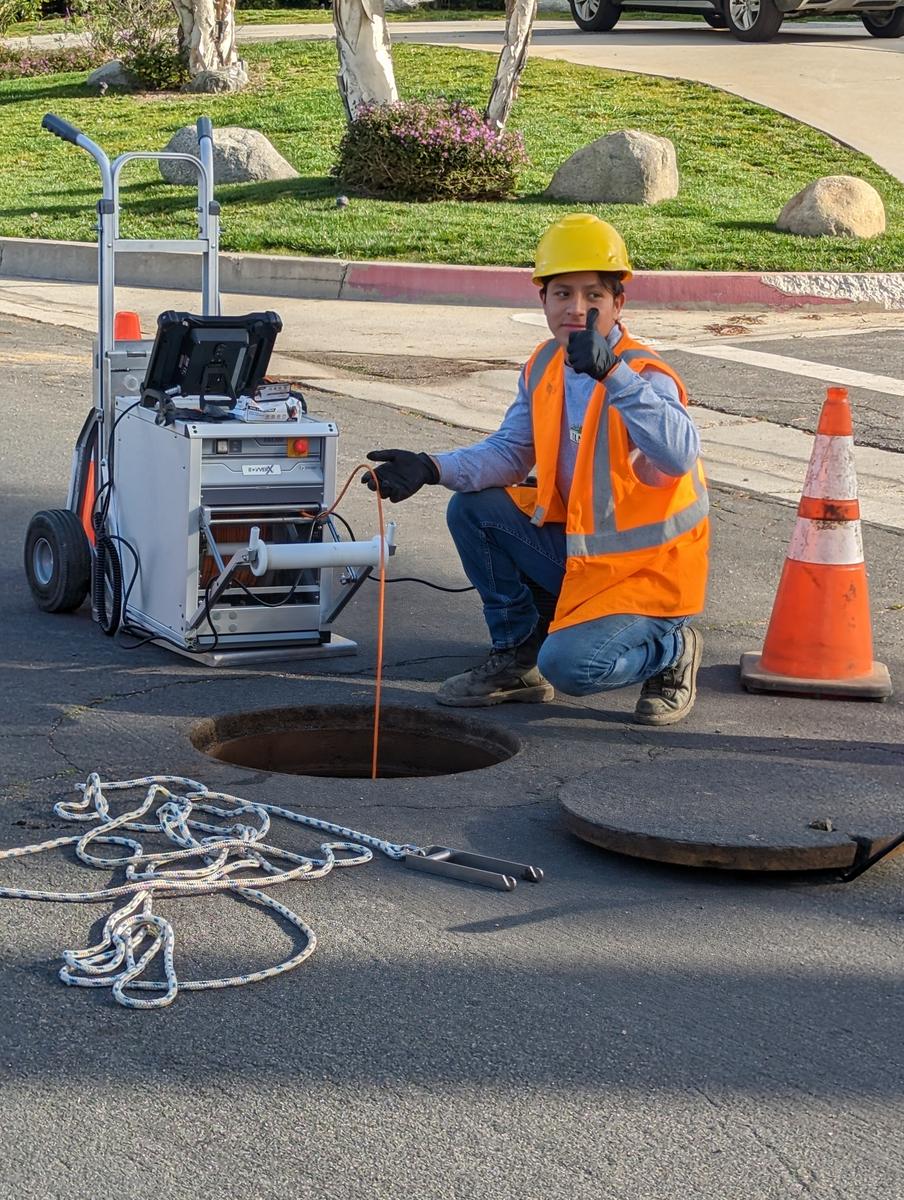
- CCTV inspection of mains with an Envirosight ROVVER X crawler camera, manhole to manhole, with footage counter and defect log. Grades on the NASSCO PACP scale, 1 to 5 for structure and for flow. See municipal CCTV inspection.
- Lateral inspection with a push camera and sonde from a cleanout, including the tie-in at the main.
- Pre-cleaning and root cutting with our own jetter, so the survey is not full of "obscured" entries. See jetting and line cleaning.
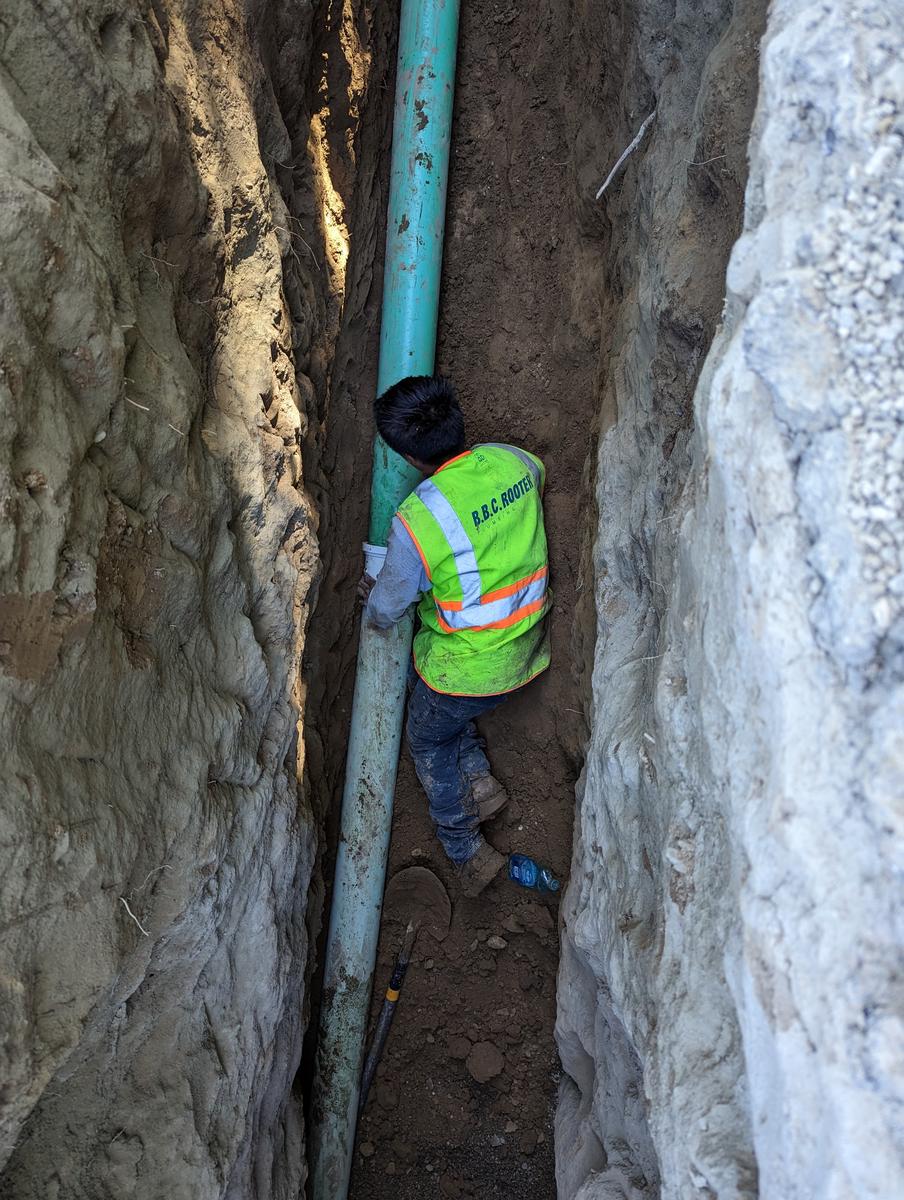
- Point repairs and lateral replacement in the street and the parkway, with shoring, backfill and pavement and sidewalk restoration.
- Trenchless work: cured-in-place lining and pipe bursting where the city or the owner wants to avoid a trench. See trenchless sewer repair.
- Emergency response on backups at city buildings, parks, libraries, fire stations and yards, any hour.
We do not bid water mains, fixtures, water heaters, gas lines or new building plumbing. If your package includes those, we tell you on the first call.
Where the work comes from
Most small city sewer work does not come out as a stand-alone bid. It comes out as task orders on on-call contracts that a prime already holds. So there are three ways we end up on a City of Los Angeles job:
- As a sub to a primeYou hold, or are bidding, an as-needed sewer, CCTV or condition assessment contract, and you need a pipe trade licence and a camera crew on your team. See for prime contractors.
- Directly on a city solicitationCity of Los Angeles bids are posted on RAMP LA, the city's procurement site, and through the Bureau of Engineering. Send us the solicitation number and we will tell you quickly whether it fits.
- For consultants and engineersA design firm needs video and a depth locate on a line before it draws a repair. We run the camera, mark the surface and hand over the coded file.
City neighborhoods we reach fast
From Yolanda Avenue we are minutes from Northridge, Reseda, Granada Hills, Porter Ranch, Chatsworth, Winnetka, Canoga Park, West Hills, Woodland Hills, Tarzana, Encino, Lake Balboa, Van Nuys, Sherman Oaks, North Hills, Panorama City, Mission Hills, Pacoima and Sylmar. We also work city sites over the hill in downtown, Brentwood and Bel Air.
Contact for City of Los Angeles work
- Company
- BBC Rooter & Plumbing
- Contact
- Babak Behzadi, Owner
- Phone
- 818-280-9135, seven days a week, emergency line 24 hours
- bbcrooter@gmail.com
- Yard
- 8635 Yolanda Ave #6, Northridge, CA 91324
- License
- CSLB #720343
- Send
- Solicitation or task order number, segment list or addresses, deliverable format, due date.
Questions from city staff and primes
Do you do sewer camera inspection for the City of Los Angeles?
Yes. We run mainline and lateral CCTV on city sewers as a sub to primes holding city contracts and on direct task orders, with PACP-coded defect logs and segment grades.
What camera equipment do you use on mains?
An Envirosight ROVVER X crawler for manhole-to-manhole runs, and push cameras with a sonde for laterals and small lines. The crew and the equipment are ours.
Can you work at night or on weekends on busy streets?
Yes. On arterials like Reseda, Sepulveda or Ventura we schedule around the traffic control plan the city approves.
Who owns the lateral in Los Angeles?
The property owner, from the building all the way to the connection at the city main. Our video log shows exactly where a defect sits so the responsibility is clear.
How fast can you mobilize?
Same day for an emergency in the Valley in most cases. Planned work is usually scheduled within the week.
Back to Municipal & Public Works · LA County agencies · CCTV inspection scope